Hieroglyphic Sign Types
Introduction
The word “hieroglyph” comes from Greek: (hierós) “sacred” + (glýphō) “I carve” — that is, “sacred carving.” The Egyptians themselves called their script mdw nṯr “the words of [the] god.”
There are three main types of hieroglyphic signs:
Phonogram (sound sign) — a sign that represents one, two or three consonants.
Logogram (ideogram, picture sign) — a sign that represents a whole word.
Determinative (classifier) — a sign with no sound value that indicates the semantic domain of the word.
The hieroglyphic script is based on the phonetic value of the sign, with additional information conveyed by signs that function as logograms and determinatives. However, the same hieroglyphic sign can serve as a logogram, a phonogram or a determinative — depending on the context.
The convention in translating is to “transliterate” (convert the hieroglyphs into their phonetic values) and then to confirm the meaning with the help of the word’s non-phonetic components (determinatives and logograms). This sounds very complicated, but you will quickly get used to it if you persevere, and it makes learning vocabulary much easier.
When reading a word, ask: how does this sign function here?
Reading Direction
Hieroglyphs were written in four directions: in horizontal rows — right to left or left to right — and in vertical columns — right to left or left to right. The Egyptians exploited this flexibility to create symmetrical inscriptions.
Reading rule: signs that have “faces” — humans, animals and birds — face the beginning of the inscription. One therefore reads “into” the signs: toward their faces. In a few religious inscriptions the rule is reversed (retrograde writing).
Sign groups: the signs are not written one after another like letters, but arranged in square or rectangular groups. Within a group, the upper sign is read before the lower. There are no spaces between words and no punctuation marks.


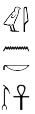
“To you [belong] life [and] dominion”
Phonogram
A phonogram indicates one or more sounds. Phonograms are uniliteral, biliteral or triliteral.
| Sign | Sound represented | Description | Type |
|---|---|---|---|
The “mouth” sign  | “r” r | Represents a single consonant only | Uniliteral |
The “house” sign  | “per” p+r | Represents two consonants | Biliteral |
The “scarab beetle” sign  | “kheper” ḫ+p+r | Represents three consonants | Triliteral |
The order of the signs in transliteration is determined by the order in which the consonants are read, not by the physical order of writing (see below, “Graphic Transposition”).
Uniliteral Signs (Alphabetic Signs)
The alphabetic signs are some twenty-five uniliteral signs (including jj, plus a few alternative forms) — each represents one consonant only. They are the basic building blocks of the hieroglyphic script and should be memorized at once, since their order determines the order of words in the dictionary and the way words are transliterated. Note that the Egyptians did not use these signs as a pure alphabet alone, but combined them with multiliteral signs and determinatives.
| Sign | Transliteration | Description | Sound |
 |
ꜣ | Egyptian vulture | a glottal stop, conventionally pronounced a as in “father” |
 |
j (i/j) | Reed leaf | i as in “it” (short i) |
 , ,  |
jj | Double reed leaf | ee as in “see,” or y as in “yes” |
 |
ꜥ | Forearm | a guttural sound like Arabic “ʿayn” (conventionally pronounced a) |
 , ,  |
w | Quail chick or coil of rope | w as in “water” at the beginning of a word; u as in “rule” in the middle or at the end of a word |
 |
b | Foot | b as in “bed” |
 |
p | Stool | p as in “pen” |
 |
f | Horned viper | f as in “fish” |
 |
m | Owl | m as in “man” |
 |
n | Water | n as in “net” |
 |
r | Mouth | r as in “red” |
 |
h | Reed shelter (courtyard) | h as in “hat” |
 |
ḥ | Twisted wick | a strong h, like Arabic ḥ |
 |
ḫ | Placenta (?) | ch as in Scottish “loch” |
 |
ẖ | Animal belly with tail | a softer ch with a y-like quality (like ch in German ich) |
 |
s (z) | Door bolt | s as in “sun” |
 |
s (ś) | Folded/hanging cloth | s as in “sun” |
 |
š | Pool | sh as in “ship” |
 |
q (ḳ) | Hill | a k pronounced deep in the throat, like Arabic qāf |
 |
k | Basket with handle | k as in “king” |
 |
g | Jar stand | g as in “go” |
 |
t | Loaf of bread | t as in “ten” |
 |
ṯ | Tethering rope | ch as in “chip” (tj) |
 |
d | Hand | d as in “dog” |
 |
ḏ | Cobra | j as in “jam” |
Transliteration
Transliteration is the conversion of each consonant written in hieroglyphs into an agreed Latin letter. Unlike the transliteration of familiar languages, Egyptian transliteration does not reflect pronunciation — the vowels were not written and the exact pronunciation is unknown — but only the written consonants.
In studying Middle Egyptian, the student will encounter different transliterations for the signs , and . The problem arises because the exact phonetic value of several signs is not known with certainty, and so different scholars have chosen different conventions.
In the British system (e.g., Gardiner) the reed leaf is transliterated ỉ, and in the European/German system j. The double reed leaf, and the two oblique strokes when they serve as a phonogram, are transliterated y in both systems. Some scholars transliterate it ii or jj.
A period “.” is used to separate the verb stem from a grammatical ending — for example in the verb form sḏm.n=f, where “.n” is the grammatical ending.
The equals sign “=” is used to attach a suffix pronoun to a verb, a noun or a preposition — for example in sḏm.n=f, where =f is the pronoun “he” attached to the verb.
The period also appears before the feminine ending t and before the plural endings w and wt — for example mw.t “mother.”
Capital letters are used at the beginning of a word that is the name of a person, a god or a land (including a city); for example, the name of the land of Egypt is transliterated Km.t, not km.t.
Weak consonants: the consonants j and jj are often missing in the writing, but are always written in transliteration. For example, the verb prj “to go out” is usually written without the j.
Conventional Pronunciation
The hieroglyphic script indicates consonants only — the vowels were not written at all. This means that we do not know for certain how Egyptian actually sounded.
To allow scholars and students to pronounce words aloud — for purposes of study and discussion only — a modern convention has been adopted: inserting the sound “e” between consonants. Thus, for example, the verb sḏm is pronounced “sedjem” — not because it originally sounded that way, but so that it can be said.
The conventional pronunciation of the special consonants:
ꜣ and ꜥ are pronounced a.
j is pronounced i.
jj is pronounced i or y.
w is pronounced w at the beginning of a word, and u elsewhere.
The e is added only between the other consonants.
For example: mꜣꜣ “to see” is pronounced “maa,” and wj “me” is pronounced “wi.”
Logogram (Ideogram)
A logogram (or ideogram) represents a whole word. Many logograms are also phonograms (that is, they have a sound value instead of representing a whole word). If the sign is meant to serve as a logogram, a vertical stroke (linear stroke) will usually appear beneath it. For example, the sign for the letter “r” — becomes the sign for the word “mouth” when it is written with a stroke (indicating that it is a logogram).
| Hieroglyphs | Transliteration | Sign type | Meaning |
|---|---|---|---|
 | r | Phonogram | The consonant r |
 | r | Logogram | The word “mouth” |
 | ḥr | Phonogram | The biliteral ḥr |
 | ḥr | Logogram | The word “face” |
The Linear Stroke
A short vertical stroke appearing beneath or beside a sign means: “read the sign as what it looks like” — that is, the sign represents the thing it depicts. For example:
 pr + stroke beneath it → “house”
 jb + stroke beneath it → “heart”
Logogram with a feminine ending: when the word is feminine, the ending t is written beside the stroke — for example njw.t “city” and ꜣḫ.t “horizon.”
The Rebus Principle
The basic principle of the hieroglyphic script: a sign representing one word can be used to write another word with an identical or similar sound, even if there is no connection in meaning between them.
Just as in English — if we wanted to write the word “belief” in pictures, we could draw a bee + a leaf — not because bees have anything to do with believing, but because the sounds match.
An example from Classical Egyptian:
The dung beetle was called ḫprr in Egyptian (Faulkner). Its sign was borrowed to write the verb ḫpr “to be, to come into being” — not because the beetle is connected with existence, but because the two words share the consonants ḫpr.
Another example: the sign pr (house plan) represents the word pr “house”, and by sound borrowing it is also used to write the verb prj “to go out”, which has nothing to do with a house.
Note: the rebus principle is the reason many phonograms look “unrelated” to the meaning they express — the link is one of sound, not of picture.
One sign, two words:
| Hieroglyphs | Transliteration | What the sign depicts | What the sign writes |
|---|---|---|---|
| pr | House plan | “house” |
 | prj | The same house plan | “to go out” |
 | ḫprr | Dung beetle | “dung beetle” |
 | ḫpr | The same beetle | “to come into being” |
The rebus creates ambiguity: if the same sign writes both pr “house” and prj “to go out”, how will the reader know which word is meant? Two mechanisms were developed for this, discussed in the following sections — the phonetic complement, which confirms the reading, and the determinative, which marks the semantic field the word belongs to. This can be seen in the table itself: in prj the mouth and the walking legs were added, and in ḫpr ḫ and p were added around the beetle; whereas when the sign writes precisely what it depicts, the stroke appears beside it.
Phonetic Complement
A phonetic complement is a uniliteral sign added to a multiliteral sign in order to confirm the reading. It can appear before the multiliteral sign, after it, or on both sides of it.
| Hieroglyphs | Transliteration | Position | Explanation | Meaning |
|---|---|---|---|---|
 | nḏm | After a triliteral |
| “sweet” Adjective |
 | tm | Before and after |
| Negative command “do not do” Verb |
 | jmj.wtj | Two cases: Before a triliteral Before and after a triliteral |
| “between” Preposition |
 - nḏm → n+ḏ+m
 -
tm → t+m
-
tm → t+m -
jmj → j+m+j
-
jmj → j+m+j -
tj → t+j
-
tj → t+jSemantic Determinative (Classifier)
The determinative has no phonetic value and is therefore not transliterated. It marks the end of the word and supplies additional information about its meaning. The determinative can be essential for translation, since hieroglyphic writing has no vowels, and a given sequence of consonants may therefore carry more than one meaning.
Examples:
| Sign | Category | Description |
|---|---|---|
 | Seated man | Marks a man's name or a male role |
 | Man with hand to mouth | Marks a word connected with the mouth (speaking, eating, etc.) |
 , ,
 | Rolled papyrus | Marks an abstract concept or writing |
 | Walking legs | Marks actions of motion |
 | Sun | Marks time, light, actions connected with the sun |
 , ,
 | Three vertical strokes | Marks the plural (more than two) |
Different determinatives for identical words — the same sequence of consonants, with a different meaning according to the determinative:
| Hieroglyphs | Transliteration | Meaning | Determinative |
|---|---|---|---|
 |
hnw | “jar” | Jar |
 |
hnw | “praise” | Man with raised arms |
 |
hnw | “family” | People + three strokes |
 |
hnw | “waves” | Water |
 |
ḥḏ | “silver” (the metal) | Bead collar |
 |
ḥḏ.t | “white linen” | Cloth |
 |
ḥḏj | “to harm, to destroy” | Bad bird (sparrow) |
 |
ḥḏ | “white, bright” | Sun |
Honorific Transposition
Honorific transposition is a feature of hieroglyphic writing in which an honored word — such as the name of a god or of a king — is written before another word out of respect, although it is actually read last. In Middle Egyptian, in a direct genitive of nouns (noun compound), the usual order is: the “thing possessed” first, followed by the “possessor”.
For example: pr sn.t — “[the] sister's house” (the house first, the sister after — the house “belongs” to the sister)
But when the “possessor” is a god's name, a king's name, or an honorific title, the scribe usually reversed the order out of respect and wrote the honored name first.
Examples (the thing possessed in red, the possessor in blue):
| Hieroglyphs (as written) | Transliteration | English | |
|---|---|---|---|
  | nṯr ḥw.t | ḥw.t-nṯr | “Estate [of the] god” (Temple) |
  | nsw.t sꜣ | sꜣ-nsw.t | “Son [of the] king” (Prince) |
 | nsw.t ḥm.t | ḥm.t-nsw.t | “Wife [of the] king” (Queen) |
Further common examples (Allen 4.15; Selden 3.2): ḥm-nṯr “priest” (literally: “servant of the god”), mdw-nṯr “words of the god” (a name for hieroglyphic writing), ḥtp-nṯr “offering of the god”. Honorific transposition is also common in personal and royal names, e.g. sꜣ-Ptḥ “son of Ptah” (Siptah), in which the god’s name Ptah is written first.
Graphic Transposition
Graphic transposition is a phenomenon similar to honorific transposition, but different in its purpose.
Here the scribe reversed the order of the signs not out of respect, but for visual reasons — to avoid an empty space in the line of hieroglyphs, or to create an aesthetic arrangement of the signs.
The main difference from honorific transposition:
Honorific transposition: concerns whole nouns within a phrase.
Graphic transposition: concerns two individual signs within a single word.
The practical rule:
Graphic transposition does not affect the reading, transliteration, or translation — it is a change in spelling only.
Common examples:
| Hieroglyphs | Actual order of the signs | Correct order for transliteration and reading |
|---|---|---|
 | tw | wt |
 | ḥꜣ.t | ꜣḥ.t |
| swtn | nsw.t |
Not every order that looks odd is a graphic transposition. In most words the order of the signs is the reading order, and transposition is a feature of individual words — you learn it from the glossary; you do not deduce it.
The transliteration always reflects the reading order, not the order of the signs; the middle column exists only to show what one sees on the stone. If you have identified a word by its signs and cannot find it in the glossary — try swapping the first two signs.
Note: nsw.t appears both here and in the section on honorific transposition. There it is a whole name placed first out of respect; here it is the order of the signs within the word itself.
Chapter Vocabulary
| Hieroglyphs | Transliteration | Type | English |
|---|---|---|---|
 | ꜣḥ.t | Noun | Arable land, field |
 | ꜣḫ.t | Noun | Horizon |
| jb | Noun | Heart |
| jmj.wtj | Preposition | Between |
 | wt | Noun | Mummy wrapping |
| pr | Noun | House |
| prj | Verb | To go out, come forth |
 | Ptḥ | Proper noun | Ptah |
 | mꜣꜣ | Verb | To see, look at |
 | mw.t | Noun | Mother |
 | mdw-nṯr | Noun phrase | Divine words (the hieroglyphic script) |
 | njw.t | Noun | Town, city |
 , ,  | nb | Noun | Lord, master |
| nsw.t | Noun | King |
 , ,  | nṯr | Noun | God |
| nḏm | Adjective | Sweet |
| r | Noun | Mouth |
 | hnw | Noun | Jar |
 | hnw | Noun | Praise, jubilation |
 | hnw | Noun | Family, household |
 | hnw | Noun | Waves |
| ḥw.t-nṯr | Noun phrase | Temple (“god’s estate”) |
 | ḥm-nṯr | Noun phrase | Priest (“god’s servant”) |
| ḥm.t-nsw.t | Noun phrase | Queen (“king’s wife”) |
 | ḥr | Noun | Face |
| ḥr | Preposition | On, upon |
 | ḥtp-nṯr | Noun phrase | Divine offering |
 | ḥḏ | Noun | Silver |
| ḥḏ | Adjective | White, bright |
 | ḥḏj | Verb | To damage, destroy |
| ḥḏ.t | Noun | White linen cloth |
| ḫpr | Verb | To become, come into being |
| ḫprr | Noun | Dung-beetle |
 , ,  | sꜣ | Noun | Son |
 | sꜣ-Ptḥ | Proper noun | Sa-Ptah (personal name) |
| sꜣ-nsw.t | Noun phrase | Prince (“king’s son”) |
 | sn.t | Noun | Sister |
 | sḏm | Verb | To hear |
 | Km.t | Proper noun | Egypt (“the Black Land”) |
| tm | Verb | To not do, cease (negative verb) |