The Adjective
Adjective
An adjective is a word that describes a property, quality or state of a noun: “good”, “great”, “wise”.
Everyday examples:
English: wise, beautiful, old
In Middle Egyptian:
The Egyptian adjective has two main uses, and they differ in the position of the adjective:
Attributive — the adjective comes after the noun and agrees with it in gender and number: nṯr nfr “a good god”.
Predicate — the adjective comes at the head of the sentence, before the subject: nfr sw “he is good”.
Forms of the adjective:
| Masculine | Feminine | |
|---|---|---|
| Singular | nfr | nfr.t |
| Plural | nfr.w | nfr.t (sometimes with plural strokes) |
In the feminine plural the adjective is usually written like the feminine singular: ḥm.wt nfr.t “good women”. Sometimes texts show the adjective in the masculine singular even after a feminine or plural noun.
The two uses side by side:
| Hieroglyphs | Transliteration | English | Use |
|---|---|---|---|
  | s nfr | “a good man” | Attributive |
 | nfr sw | “he is good” | Predicate |
The difference from English:
In English the attributive adjective precedes the noun and the predicative adjective follows the verb “to be” — “the good man” (attributive) vs. “the man is good” (predicate). Egyptian has no such copula, and the distinction is made by word order.
Attributive Use of the Adjective
In attributive use the adjective describes the noun within a noun phrase — the phrase is not a sentence.
Everyday examples:
English: the old man
In Middle Egyptian:
The noun comes first and the adjective after it — always. The adjective agrees with the noun in gender and number.
Examples (adjective in orange):
| Hieroglyphs | Transliteration | English |
|---|---|---|
  | s nfr | “[A] good man” |
  | s.t nfr.t | “[A] good woman” |
  | pr ꜥꜣ | “[A] big house” |
  | pr.w ꜥꜣ.w | “Big houses” |
  | sš jqr | “[An] excellent scribe” |
  | ḥm.wt nfr.t | “Good women” |
Several adjectives: when several adjectives describe the same noun, all of them come after it. A suffix pronoun and a demonstrative pronoun come before the adjectives: sḫr.w=j jqr.w “my excellent plans”, nṯr pf mnḫ “that beneficent god”.
After a direct genitive: an adjective describing the first noun comes after the whole phrase. The gender and number of the adjective show which noun it refers to: ḥm.t wꜥb nb.t “every priest’s wife” (nb.t is feminine — it describes ḥm.t).
A collective noun takes an adjective in the feminine singular: rmṯ(.t) nb.t “all people” (see “Collective Nouns” in the chapter “Basic Concepts in Grammar”).
Adjective as a noun: an adjective can stand alone, without a noun, and serve as a noun: nfr “good, a good [man]”, nfr.t “a good [thing], a beautiful [woman]”, nfr.w “the good ones”. Sometimes a determinative is added to clarify what is meant. As a noun it can take a suffix pronoun, a demonstrative pronoun or another adjective: nfr pn “this good one”.
The nfr ḥr Construction
In this construction the adjective serves as a noun and comes before another noun in a genitive: nfr ḥr “good of face” (= “pleasant, kind”). The construction describes a quality of a person or thing, and the quality is attributed to the “owner” — ꜥšꜣ sr.w “many of sheep” = “one who has many sheep”.
Examples:
| Hieroglyphs | Transliteration | Literal translation | Meaning |
|---|---|---|---|
 | qꜣj sꜣ | “high of back” | “arrogant”, “insolent” |
 | ꜣw jb | “long of heart” | “happy”, “cheerful” |
 | wsr pḥtj | “great of strength” | “strong” |
 | mꜣꜥ ḫrw | “true of voice” | “justified”, “triumphant” |
When the phrase describes a noun, its adjective agrees with the noun described in gender and number:
| Hieroglyphs | Transliteration | English |
|---|---|---|
 | šps qꜣj sꜣ | “[An] arrogant nobleman” |
 | šps.t qꜣj.t sꜣ | “[An] arrogant noblewoman” |
 | s.w nfr.w ḥr | “Kindly men” |
 | ḥm.t ꜣw.t jb | “[A] happy woman” |
 | ḥm.wt ꜣw.t jb | “Happy women” |
Predicative Use of the Adjective
In predicative use the adjective is the predicate of the sentence: “the man is good”. This is an adjectival sentence (see the section “The Adjectival Sentence” in Chapter 9).
Everyday examples:
English: The water is cold
In Middle Egyptian:
The adjective comes at the head of the sentence and the subject after it. In this use the adjective does not agree with the subject — it always comes in the masculine singular form. When the subject is a personal pronoun, it comes as a dependent pronoun.
Examples (adjective in orange):
| Hieroglyphs | Transliteration | English |
|---|---|---|
  | jqr sḫr pn | “This plan [is] excellent” |
 | nfr ḥm.t tn | “This woman [is] beautiful” |
 | nfr sw | “He [is] good” |
Exclamation: one exception — in an exclamation the ending .wjj is added to the adjective: nfr.wjj ḥm.t tn “how beautiful is this woman!”.
| Hieroglyphs | Transliteration | English |
|---|---|---|
 | nfr.wjj ḥm.t tn | “How beautiful [is] this woman!” |
The Adjective nb “All, Every”
nb “all” is a special adjective. Its meanings:
“all”
“every/each one”
“any”
“all kinds of”
Position in the sentence:
Like every attributive adjective, nb comes after the noun and agrees with it in gender (nb / nb.t). When there are several adjectives, nb comes first among them.
Examples:
| Hieroglyphs | Transliteration | English |
|---|---|---|
 | ḫ.t nb.t nfr.t | “All good things” |
 | ḥr nb | “Everyone” |
 | rꜥ nb | “Every day” |
   | jꜣ.t nb.t šps.t | “Every noble office” |
nb “all” differs from other adjectives in two respects:
It is not used as a predicate.
It does not stand alone as a noun. Therefore nb with no noun before it is the noun nb “lord, owner” — nb pn “this lord”.
Word order distinguishes the two words: pr nb “every house” (nb an adjective, after the noun) vs. nb pr “the owner of the house” (nb a noun, first member of a genitive).
| Hieroglyphs | Transliteration | English |
|---|---|---|
 | pr nb | “Every house” |
 | nb pr | “Lord of the house” |
Nisba
A nisba is an adjective derived from a noun or a preposition, meaning “belonging to, related to”. In Egyptian nisbas are derived from prepositions as well — something rare in other languages.
In other words: it is a way of turning a noun into an adjective of relation.
How is a nisba formed?
For a masculine noun:
| Gender | Singular | Plural |
|---|---|---|
| Masculine | noun + jj | noun + jjw |
| Feminine | noun + jjt | noun + jjwt |
For example → changing  rsw (“south wind” ~ south) into the adjective “southern”:
| Gender | Singular | Plural | ||
|---|---|---|---|---|
| Masculine |  | rs.jj |  | rs.jjw |
| Feminine |  | rs.jjt |  | rs.jjwt |
For a feminine noun:
| Gender | Singular | Plural |
|---|---|---|
| Masculine | noun + tjj | noun + tjjw |
| Feminine | noun + tjjt | noun + tjjwt |
For example → changing  mḥ.t (“Delta marshes” ~ north) into the adjective “northern”:
| Gender | Singular | Plural | ||
|---|---|---|---|---|
| Masculine |  | mḥ.tjj |  | mḥ.tjjw |
| Feminine |  | mḥ.tjjt |  | mḥ.tjjwt |
The form behaves like an ordinary adjective.
Examples (nisba adjective in orange):
| Root | Hieroglyphs | Transliteration | English |
|---|---|---|---|
nṯr “god” “god” |  | pr nṯr.jj | “divine house” |
bj.t “bee” “bee” |  | bj.tjj | “the one of the bee” [King of Lower Egypt] |
ḥr “upon” “upon” |  | ḥr.jj | “upper, which is upon” |
A nisba behaves like an ordinary adjective: it comes after the noun, agrees with it, and can serve as a noun (bj.tjj “King of Lower Egypt”).
Two special nisbas are discussed elsewhere: n(.jj) — the genitival adjective (chapter “The Noun and the Noun Phrase”), and nt.jj — the relative adjective (chapter “Relativity”).

Illustration of line 3 of the stela of Horemkhauef, Dynasty 13, Hierakonpolis
ssn.t ṯꜣw nḏm n mḥ.jjt — “to breathe the sweet air of the north wind”
Degrees of Comparison
Comparison
Egyptian has no special comparative form (“better”). The same adjective serves for ordinary description and for comparison, and comparison is marked by the preposition r “relative to” after the adjective: nfr r “better than”.
Example (preposition in red):
   |
Hieroglyphs |
| wsr mšꜥ r ṯꜣtj | Transliteration |
| “[The] army is stronger than [the] vizier” | English |
|---|---|
| “[The] army [is] more powerful than [the] vizier” | English |
  |
Hieroglyphs |
| ꜥꜣ pr n(.jj) nḏs r pr n(.jj) špsw | Transliteration |
| “[The] house of [the] commoner is greater than the house of [the] noble” | English |
|---|---|
| “[The] commoner[’s] house [is] bigger than [the] house of [the] nobleman” | English |
  |
Hieroglyphs |
| nṯr mnḫ r nṯr nb | Transliteration |
| “a god more beneficent than any god” | English |
|---|---|
| “[A] god more beneficent than any god” | English |
   |
Hieroglyphs |
| ꜥꜣ sw r=j | Transliteration |
| “He is greater than I” | English |
|---|---|
| “He [is] greater than I” | English |
Superlative
The superlative has no special form either. It is expressed in these ways:
The same preposition r, compared with “all”: nfr r ḫ.t nb.t “better than everything” = “the best”.
The adjective in a genitive with the same adjective in the plural: wr wr.w or wr n wr.w “great one of the great ones” = “the greatest of all” (like “king of kings”).
The adjective with jm.jj “who is among”: wr jm.jj sꜥḥ.w “the greatest among the nobles”.
| Hieroglyphs | Transliteration | English |
|---|---|---|
 | wr wr.w | “[The] greatest [of the] great” |
 | ꜥḥ qꜣj r ḫ.t nb.t | “[A] palace higher than anything” |
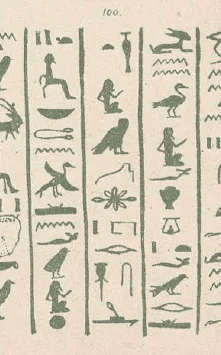
wr ḥs.t=j m stp-sꜣ r smr wꜥ.tj nb
“My praise in the palace was greater than that of any sole companion”
The great inscription in Tomb 3 at Beni Hasan (Khnumhotep II), Dynasty 12.
Hand copy: Newberry, Beni Hasan I (1893), pl. 25; cols. 99–101.
Chapter New Vocabulary
| Hieroglyphs | Transliteration | Type | English |
|---|---|---|---|
 | ꜣw | Adjective | Long |
 | jꜣ.t | Noun | Office, function |
 | jm.jj | Nisba (adjective) | Who is in, among |
 | ꜥšꜣ | Adjective | Many, numerous |
 | wꜥb | Noun | wꜥb-priest; pure |
 | wꜥ.tj | Adjective | Sole, single |
 | wsr | Adjective | Strong, powerful |
| bj.tjj | Nisba (adjective) | King of Lower Egypt |
 | pḥtj | Noun | Strength, might |
 | mꜣꜥ | Adjective | True, just |
| mḥ.jjt | Noun | North wind | |
| mḥ.t | Noun | The Delta; the North |
| mḥ.tjj | Nisba (adjective) | Northern |
 | mšꜥ | Noun | Army |
| nṯr.jj | Nisba (adjective) | Divine |
| rs.jj | Nisba (adjective) | Southern |
| rsw | Noun | The South |
 | ḥs.t | Noun | Favour, praise |
 | ḫ.t | Noun | Thing; property |
 | sꜣ | Noun | Back |
 | smr | Noun | King's friend, courtier |
 | sr | Noun | Sheep |
 | ssn | Verb | To breathe, smell (caus.) |
 | stp-sꜣ | Noun | Palace |
 | šps / špsw | Adjective / noun | Noble; nobleman |
 | qꜣj | Adjective | High, tall |
 | ṯꜣw | Noun | Breath, air; wind |