
The Verb
The Verb
The verbal system is the heart of Egyptian grammar — and also its most complicated part. In this chapter we will get to know the verb forms, their functions in the sentence, and the constructions built from them. First — a short map of terms.
Basic Terms
Given the complexity of the Middle Egyptian verbal system, it is worth opening this chapter by settling the basic terms used to describe it. The need is all the greater because different grammars do not always define the same terms in the same way, nor assign them to the same grammatical categories, which can cause confusion already at the earliest stage of study. Moreover, not every reader necessarily remembers the basic grammatical terms from earlier studies, so this brief clarification is meant to serve as an orderly, clear, and accessible starting point for the rest of the chapter. After a brief analysis, the concepts will be discussed at length.
Form — what does the verb look like?
These are the actual forms of the verb in Middle Egyptian:
sḏm=f — the basic structure of verb + suffix pronoun. sḏm means “to hear” and f means “he,” so literally: “he hears / he heard.” This is one of the basic forms of Egyptian grammar, and it can be used in several ways depending on the context.
sḏm.n=f — the same form, but with n inserted between the verb stem and the pronoun (sḏm.n=f). This usually marks an action completed in the past. You can think of the n as a sign that the thing has already happened.
The stative (Stative) — (also called Pseudo-Participle or Old Perfective) — a completely different set of endings, not based on suffix pronouns. It describes a state, not an action. For example: “he is seated,” “she has arrived” — not what happened, but the state that resulted from it. This is one of the oldest verb forms in Egyptian.
The prospective (Prospective) — (sometimes also called Subjunctive) — a form used for things that are intended, desired, or expected to happen. It points toward the future or toward a goal. For example: “so that he may hear,” “that he may go.”
The imperative (Imperative) — the command form, for example: “hear!”, “go!”. Very simple.
The infinitive (Infinitive) — a separate section is devoted to it below.
The participle (Participle) and the relative form (Relative Form) — verb forms that function as adjectives and describe a noun: “the man who hears,” “the temple that the king built.” They are discussed in the chapter “Relativity”.
Function — what role does the verb play in the sentence?
The same written verb form can fill different functions. This is where the terms “circumstantial” (circumstantial), “nominal” (nominal), and “emphatic” (emphatic) come in.
Circumstantial — a form of adverbial character. In a subordinate clause it describes the circumstances of the main action (“when he spoke”, “at the time she arrived”); after the particle jw it serves as the predicate of a main clause (“he hears”).
Nominal — a form that functions as a noun: “(the fact) that he heard”. It can serve as subject or object, and its chief use is in the emphatic sentence.
Emphatic — a functional use in which the verb form serves to highlight an adverbial element — time, place or manner — rather than the action itself. Instead of “he heard the message”, the focus of the sentence shifts to when, where or how he heard it: “it was yesterday that he heard the message”. The verb itself recedes somewhat into the background, and the circumstance is the point of the statement. Some grammarians regard this as a subtype of the nominal use; others give it a category of its own. Either way, the issue here is where the emphasis lies, not the verb form as such.
Indicative — a main clause making a direct statement: “he heard the words”. Such a clause has no special form: the particle jw is used, followed by the circumstantial form (jw sḏm=f, jw sḏm.n=f).
Aspect — what is the character of the action, or of its unfolding in time?
Complete (Perfective / Perfect) — the action is complete. It is viewed as whole, finished, closed. For example: “he heard.”
Incomplete (Imperfective / Imperfect) — the action is ongoing, repeated or habitual. It is not viewed as complete. For example: “he used to hear”, “he hears regularly”.
Aorist — a general, timeless or habitual action: not a particular event at a particular time, but something that is true in general or happens routinely (“the sun rises”, “the scribe reads texts”). In Middle Egyptian this is the role of jw sḏm=f.
These terms are borrowed from general linguistics and applied to the Egyptian verb in order to describe the temporal quality of the action, not its outward form.
Constructions
Pseudoverbal — an adverbial sentence whose predicate is a preposition + infinitive: jw=f ḥr sḏm “he is hearing” (lit. “he is upon hearing”), jw=f r sḏm “he is about to hear”. It contains no conjugated verb, yet it does the work of a verb.
Emphatic sentence and participial statement (Emphatic / Cleft sentence) — constructions that shift the focus of the sentence onto a single element: “it is at night that he sails” (emphatic), “it is the king who heard” (participial statement). The emphatic sentence is discussed in this chapter; the participial statement — later on.
Negative (Negation constructions) — Egyptian has several negative particles, and they are not interchangeable. Different particles attach to different verb forms and occur in different contexts. One cannot simply add “not” anywhere; the choice of negative particle is directly bound up with the verb form being used and the type of clause in which it appears. Negation is therefore a genuinely structural, verb-bound problem.
Sequential construction (Sequential / Narrative construction) — Egyptian links verb forms to one another to convey a sequence of events. Which form opens the sequence and which forms follow it is governed by particular rules. The verb forms involved are genuine conjugated forms, but the pattern by which they are linked is a construction in its own right.
Tense — when does the action take place?
This is where Middle Egyptian really differs from languages such as English, Hebrew or Arabic, and where many students tend to get tangled up.
Middle Egyptian is not primarily a tense language. Many European and Semitic languages encode tense — past, present, future — directly in the verb form. Egyptian, by contrast, tends to encode in the verb aspect (complete versus ongoing action) and function (main verb, circumstantial verb, nominal verb). Tense — when the thing happens — is often inferred from context or expressed by other means.
Nevertheless, Egyptian of course does refer to time, only in a different way:
Past — usually expressed by the sḏm.n=f form, which reliably marks a completed past event in main clauses. The stative can also describe a present state resulting from a past action (“he has arrived” in the sense “he is here now, having arrived”). Certain uses of sḏm=f with action verbs can also be read as past.
Present — in Middle Egyptian, the actual present is expressed most naturally by pseudoverbal constructions, especially ḥr + infinitive (“he is in the course of hearing”). The simple form sḏm=f does not clearly mark “present tense” the way the English present does.
Future — the prospective sḏm=f is used for desired, planned or expected actions. The pseudoverbal construction r + infinitive (“he is about to hear”) also expresses the future. The two are not fully identical: the prospective leans more toward purpose, intention or wish, and r + infinitive toward what is about to happen.
General / Habitual / Timeless — jw sḏm=f expresses things that are always or habitually true. This is not past, present or future, but something above the division into tenses.
Finite and non-finite verbs — is the verb “anchored” to a subject?
This distinction cuts across everything said above, and it is very useful.
Finite verbs — fully conjugated verbs, that is, verbs anchored to a particular subject and carrying grammatical information such as person, number and aspect. They can stand alone as the main predicate of a sentence. In Middle Egyptian sḏm=f, sḏm.n=f, the prospective and the stative are all finite forms — all are bound to a particular subject and form a complete predicate.
| Form | Hieroglyphs | Transliteration | English |
|---|---|---|---|
| sḏm=f |  | jw mꜣꜣ s ḥm.t=f m pr | “The man sees his wife in the house” |
| sḏm.n=f |  | jw mꜣ.n sš r jt=f | “The scribe looked after his father” |
| Prospective |  | ms=s m ꜣbd 1 pr.t sw 15 | “She will give birth in the first month of Peret, on day 15” |
| Stative |  | jw=j ꜣṯp.kw(j) m rm.w | “I am loaded with fish” |
The name sḏm=f is merely a convention: the =f is not part of the form but a stand-in for the subject. Any subject can follow the verb — a noun ( jw mꜣꜣ s... “the man sees”), a noun phrase, or a suffix pronoun ( mꜣꜣ**=f** “he sees”). The rule is one of position, not type: the subject comes immediately after the verb. The exception is the stative, in which the subject is not a separate word but is marked by the ending itself ( ꜣṯp.kwj “I am loaded”)
Non-finite verbs — not anchored to a subject and not fully conjugated. They function as a verbal idea rather than a complete assertion, and serve as nouns, as modifiers or as part of other constructions. The main forms: the infinitive and the participle. A complete main clause cannot be built from them alone.
| Form | Hieroglyphs | Transliteration | English |
|---|---|---|---|
| Infinitive |  | m pr.t ḥm-nṯr | “at the going forth of [the] priest” |
| Infinitive |  | jw=f ḥr bḥs | “he is hunting” |
| Participle |  | s jrj sw | “[the] man who did it” |
pr.t “going forth” does not mark who is going forth; the priest attaches to it as a noun in a genitive. In jw=f ḥr bḥs the subject (=f) is attached to jw, not to the infinitive bḥs. The participle jrj describes s like an adjective (“the one who does”). None of them can serve alone as the predicate of a sentence.
Summary table
| Term | What kind of concept does it belong to? |
|---|---|
| sḏm=f | Form (inflected, finite) |
| sḏm.n=f | Form (inflected, finite) |
| Stative | Form (inflected, finite) |
| Prospective | Form (inflected, finite) |
| Imperative | Form (inflected, finite) |
| Infinitive | Form (non-finite) |
| Circumstantial | Function |
| Nominal | Function |
| Emphatic | Function |
| Perfective / Perfect | Aspect |
| Imperfective / Imperfect | Aspect |
| Aorist | Aspect |
| Pseudoverbal | Construction type |
| Cleft sentence | Construction type |
| Negation constructions | Construction type |
| Sequential / narrative | Construction type |
| Finite / Non-finite | Verb category |
| Transitive / Intransitive | Verb type |
| Past / Present / Future | Tense (inferred from context) |
Root Classes
Egyptian verbs fall into classes according to the shape of their root. Each consonant of the root is called a radical. A verb contains between two and six radicals (five or six are rare, and usually the result of gemination). Since the vowels are unknown, on this site we call the radicals “consonants”.
Root types
Strong roots:
| Name | Root structure | Middle Egyptian example | Translation | |
|---|---|---|---|---|
| 2-lit., biliteral | Two consonants |  | ḏd | “to say” (to say) |
| 3-lit., triliteral | Three consonants, the last not j or w |  | ꜥrq | “to bend” (to bend) |
| 4-lit., quadriliteral | Four consonants, the last not j or w |  | ptpt | “to trample” (to trample) |
| 5-lit., quinquiliteral | Five consonants |  | nhmhm | “to shout” (to yell) |
Weak roots:
| Name | Root structure | Middle Egyptian example | Translation | |
|---|---|---|---|---|
| 3ae-inf., 3-inf | Three consonants, the last weak ( j / w) |  | dmj | “to touch” (to touch) |
| 4ae-inf., 4-inf | Four consonants, the last weak ( j / w) |  | msḏj | “to hate” (to hate) |
| 2ae-gem., 2-gem | Three consonants, the second and third identical |  | mꜣꜣ | “to see” (to see) |
| 3ae-gem., 3-gem | Four consonants, the third and fourth identical |  | snꜥꜥ | “to slip” (to smooth) |
Strong verbs are verbs whose stem does not change in conjugation — that is, the root consonants remain the same in all grammatical forms.
Weak verbs (Mutable verbs / Weak Verbs) are verbs whose stem changes in conjugation — that is, one or more root consonants weaken or disappear in certain grammatical forms.
Causative Verbs
In Middle Egyptian, causative verbs (Causative verbs) are verbs denoting an action in which the subject causes someone or something to perform an action, that is, “to bring it about that X does Y”. Semantically they parallel the causative stems of the Semitic languages (such as the Hebrew hiphil) and constructions like make / cause to in English.
The main means of forming causative verbs in Middle Egyptian is the prefix s  added before the root.
Examples:
| Basic root | Meaning | Causative verb | Meaning | |
|---|---|---|---|---|
ꜥnḫ | “to live” |
sꜥnḫ | “to cause to live / to make live” | |
ḏd | “to say” |
sḏd | “to cause to say / to tell” | |
ḫpr | “to come into being / to happen” |
sḫpr | “to cause to come into being / to create” |


Causative verbs are always transitive. The basic root may be intransitive — ꜥnḫ “to live” takes no object — but the causative derived from it always takes a direct object: sꜥnḫ=f wj “he makes me live”.
When there is no causative form: the construction rdj + prospective
Not every verb has an s- form. Common verbs such as jj / jwj “to come”, jnj “to bring” and rdj itself have no such form at all, and causation is expressed by a construction: the verb rdj followed by a prospective sḏm=f.
| Meaning | The construction | The nonexistent form |
|---|---|---|
| “to cause to come” | rdj jwt | *sjwj |
| “to cause to bring” | rdj jnt | *sjnj |
| “to cause to give” | rdj dj | *srdj |
The construction became so common that in Coptic it took the place of the old s- forms.
The Verb and Its Parts
Verbs are words that languages use to describe actions. Within a clause or sentence, nouns and pronouns are usually the subject — what is being talked about — while the verb is usually the predicate, that is, what is said about the subject. In Egyptian, clauses or sentences can be formed without a verb.
A verb is a word that denotes one of the following:
An action (walked, writes, will hunt)
An occurrence (fell, broke)
A state (sat, stands, will sleep)
Who performs the action?
Every action usually has at least one participant: someone/something that does something or is in some state.
In grammar, the participants are called:
Subject — who or what performs the action
Sometimes also an object — who or what receives the action
In Middle Egyptian:
There are two different types of verbs: transitive verbs and intransitive verbs . The difference between these two categories concerns the relation between the action expressed by the verb and the performer of the action, that is, the person or thing carrying out the action.
Parts of a verb:
Root - a root is a fixed set of consonants (usually three, sometimes two or four) that represents the basic meaning of the verb. These consonants do not appear on their own but are set into patterns that add grammatical meaning to it.
Stem - the morphological-grammatical structure obtained when the verbal root is set into a particular pattern (verbal stem, tense, person, number and gender). Whereas the root expresses the basic lexical meaning, the stem expresses the grammatical form in which that meaning is realized.
Verbal endings - part of the verb's own conjugation system. That is, they mark grammatical values of the verb such as tense/aspect, mood, or membership in a particular conjugation pattern.
Suffix pronouns - not part of the verb's conjugation system, but pronouns attached to it that fill a syntactic role in the sentence (usually subject, object or possession).
The verb is built in layers: root → stem → verbal ending → suffix pronoun. In a strong verb the stem is identical to the root; in a weak verb the stem changes from form to form:
| Root | Stem | With verbal ending | With suffix pronoun | Translation |
|---|---|---|---|---|
| sḏm “to hear” (strong) | sḏm (identical to the root) | sḏm.n | sḏm.n=f | “he heard” |
| mrj “to love” (third-weak) | mr (basic stem) | mr.n | mr.n=f | “he loved” |
| mrj “to love” (third-weak) | mrr (geminated stem) | — | mrr=f | “(it is in …) that he loves” |
n is a verbal ending: it is part of the verb form and marks the form sḏm.n=f. =f is a suffix pronoun: it is not part of the verb but its subject.
Suffix Conjugation
The suffix conjugation is the system of verb forms in which the subject — a noun or a suffix pronoun — comes after the verb. It includes sḏm=f, sḏm.n=f, sḏm.t=f, sḏm.jn=f and other forms.
Two basic rules characterize all forms of the suffix conjugation:
a. The subject — a noun or a suffix pronoun — always comes after the verb.
b. Form names such as sḏm=f are merely arbitrary labels: sḏm stands for any verbal root, and the suffix f is the third person masculine singular pronoun, chosen by convention. The verb form itself is the same for every person — thus, for example, wnm=k (“you ate”) follows exactly the same grammatical rules as sḏm=f “he heard”.
Examples (verb in blue, subject in red):
| Hieroglyphs | Transliteration | English | Form |
|---|---|---|---|
  | sḏm sš | “[the] scribe hears” | sḏm=f (subject: noun) |
 | sḏm=f | “he hears” | sḏm=f (subject: suffix pronoun) |
 | sḏm.n=f | “he heard” | sḏm.n=f |
A single written form can represent several grammatical forms — context decides.
The forms belonging to the suffix conjugation:
| Form | Identifying mark | Function |
|---|---|---|
| sḏm=f | None | Circumstantial, nominal, prospective — in a single spelling |
| sḏm.n=f | n | Past — “he heard” |
| sḏm.t=f | t | “until he hears”, “before he heard” — after n and r |
| sḏm.jn=f | jn | Narrative — “then he heard” |
| sḏm.ḫr=f / sḏm.kꜣ=f | ḫr / kꜣ | Rare — beyond the scope of this guide |
The passive: tw after the verbal ending — sḏm.tw=f, sḏm.n.tw=f, sḏm.jn.tw=f.
What does not belong: the stative — in it the subject is marked by the verbal ending itself, not by the word that follows.
Features of Verbs
The properties of verbs are the grammatical and semantic features that define how verbs behave within the language system. These properties affect conjugation, the syntactic structure of the sentence and the meaning the verb conveys. There are four main grammatical properties: tense, aspect, mood and voice.
Tense
Tense describes the time of the action relative to the moment of speaking.
Everyday examples:
English: he wrote, he will write
In Middle Egyptian:
There is no “orderly” tense system as in English
There are no separate conjugations for each tense
Context matters more than the form itself
Even so, some forms are usually associated with:
Past (similar to, but not the same as, the Past Tense)
Present (similar to, but not the same as, the Present Tense)
Future (similar to, but not the same as, the Future Tense)
This is a tendency, not a rigid rule.
Aspect
Aspect describes the character of the action, not its time.
It answers questions such as:
Has the action been completed?
Is it ongoing?
Is it repeated again and again?
Modern examples — both of the following sentences can be in the past:
I read the book
I used to read books every evening
Both are past, but:
The first describes a completed action (perfective / completed action)
The second describes a repeated (habitual / iterative action) / ongoing (progressive action) action
This is the difference between tense and aspect.
In Middle Egyptian:
Many of the verb forms are distinguished mainly by aspect, and only indirectly by tense.
So when studying Egyptian, one does not ask “what tense is this?” but “what kind of action is this?”
Mood
Mood describes the speaker's attitude to the action — whether it is a fact, a command, a wish or a possibility. It answers questions such as:
Does the speaker present the action as a fact?
Does he command that it be done?
Does he express a wish or a condition?
Modern examples — the following three sentences refer to the same action:
He writes
Write!
If only he would write
All three concern writing, but:
The first presents a fact / is declarative → (Indicative)
The second expresses a command / order → (Imperative)
The third expresses a wish / desire (Prospective)
Voice
Voice describes the relation between the verb and its subject — whether the subject performs the action or receives it. It answers questions such as:
Who performed the action?
To whom was the action done?
Modern examples — the following two sentences describe the same action:
The carpenter built the house
The house was built by the carpenter
Both describe the same building, but:
The first highlights the performer of the action — active (Active)
The second highlights the recipient of the action — passive (Passive)
Transitive Verb
A transitive verb denotes an action that passes from the subject to a direct object, that is, an action directed at an entity other than its performer. Its meaning is therefore syntactically incomplete without naming the object the action applies to.
Everyday examples:
English: he ate the bread, he built the house
In Middle Egyptian: most common verbs are transitive.
Examples (verb in blue, subject in red, object in green):
| Hieroglyphs | Transliteration | English |
|---|---|---|
   | sḏm sš mdw | “[The] scribe hears [the] speech” |
    | jw mꜣꜣ s ḥm.t=f | “[The] man sees his wife” |
Intransitive Verb
An intransitive verb denotes an action or state that concerns the subject itself and does not pass to a direct object. Its syntactic meaning is therefore complete even without naming an object to which the action applies.
Everyday examples:
English: he slept, she came
In Middle Egyptian: intransitive verbs express motion (e.g. “to come”, “to go”) or state (e.g. “to sit”, “to lie down”). Intransitive verbs behave differently from transitive verbs.
Examples (verb in blue, subject in red):
| Hieroglyphs | Transliteration | English |
|---|---|---|
 | jj.n=f | “He came” |
  | wbn rꜥ | “[The] sun shines” |
Infinitive
An infinitive is a noun derived from a verbal root. It appears without person, without a defined tense, and functions like a noun. The infinitive describes the action itself, not the one who performs it.
Everyday examples:
English: we need to cease fighting, they plan to marry in the summer
This form must be distinguished from the action noun (Action noun, Verbal noun, Gerund).
Compare:
Infinitives → to write, to run, to hear
Action nouns → writing (as in “the writing”), a run, hearing
In Middle Egyptian:
The infinitive is a basic and very important form; it is used:
As a kind of noun:
As the object of another verb
As the object of a preposition
As a heading (narrative infinitive - Narrative Infinitive)
In verb-like constructions (Pseudoverbal constructions)
Morphology:
The infinitive is always masculine singular, even with the addition of t.
Strong verbs → the root is used (exception: šm.t → šm even though the root is strong)
Geminating verbs → full writing
Weak verbs → the final consonant is dropped and replaced by t (e.g. jr.t → jrj).
Biliteral causative verbs (prefix s) → t is added (e.g. sḏd.t → sḏd).
Irregular verbs → rdj.t → rdj, jn.t → jnj, jj.t / jw.t → jj; mꜣꜣ → mꜣꜣ (with a suffix pronoun: mꜣ=f or mꜣn=f).
Example (the verb in blue, the subject in red, the object in green (noun phrase)):
    |
Hieroglyphs |
|
| jw mꜣ.n=f pr.t wḫt | Transliteration | |
| “He saw the coming forth of the darkness” | English | |
|---|---|---|
| “He saw [the] emergence [of the] darkness” | English |
The infinitive after prepositions — each preposition creates a different meaning. The combinations are idiomatic and must be learned one by one:
| Combination | Meaning | English |
|---|---|---|
| r + infinitive | Purpose — “in order to (do X)” | Purpose – “in order to (do X)” |
| ḫft + infinitive | Simultaneity — “at the time when…” | Temporal coincidence—“at the time of,” “when” |
| m-ḫt + infinitive | Posteriority — “after…” | Subsequent action—“after (doing / having done X)” |
| tp-ꜥ + infinitive | Anteriority — “before…” | Anterior action—“before (doing X)” |
| n + infinitive | Cause — “from… / because of…” | Cause—“from (doing X)” |
| m / ḥr + infinitive | Simultaneity — “while…” | Simultaneity—“while (doing X),” “at (doing X)” |
| nn + infinitive | Negation of an accompanying action — “without…” | Negation—“without (doing X)” |
Examples:
| Hieroglyphs | Transliteration | English | Structure |
|---|---|---|---|
 | jw=f ḥr wnm | “He is eating” | ḥr + infinitive |
 | jw=f r wnm | “He is about to eat” | r + infinitive |
 | m pr.t ḥm-nṯr | “When the priest goes out” | m + infinitive |
 | ḫft jj.t=f | “At the time of his coming” | ḫft + infinitive |
 | m-ḫt mꜣꜣ | “After he saw” | m-ḫt + infinitive |
r + infinitive — purpose:
The preposition r “to, toward” before an infinitive marks purpose — “in order to…”: here ms “to present” is the infinitive, and sw “him/it” is its object (ḥsq “cutting off” at the head of the phrase is also an infinitive):
 |
Hieroglyphs |
|
Transliteration |
| “Cutting off the head in order to present it to the king” | English |
|---|---|
| “Cutting off [the] head in order to present it to [the] sovereign” | English |
n + infinitive — cause:
The preposition n “to, for” before an infinitive marks cause — “from…”, “because…”: here mꜣn=f is the infinitive of mꜣꜣ “to see” (in the stem mꜣn, used before a suffix pronoun), and the pronoun =f is the object of the seeing — “to see him”:
 |
Hieroglyphs |
|
Transliteration |
| “The heart of His Majesty was in joy at seeing him” | English |
|---|---|
| “The heart of His Majesty was in joy at seeing him” | English |
The infinitive as a heading (Narrative Infinitive) — used to describe actions in sequence, common in headings, lists and biographical texts: the actions are presented as a list of events, without full sentences. The agent is usually introduced by jn “by”.
Example:
 |
Hieroglyphs |
| jj.t m ḥtp r ẖnw jn mšꜥ | Transliteration |
| “The return in peace of the army to the residence” | English |
|---|---|
| “[The] return in safety to [the] residence by the army” | English |
The subject and object of the infinitive:
Infinitive of an intransitive verb → the subject can be a suffix pronoun or a noun in a genitive relation (e.g. pr.t s “the going out of the man”, pr.t=f “his going out”).
Infinitive of a transitive verb → as with an intransitive verb, but jn “by” may be used. The object can be a suffix pronoun, a noun in a genitive relation, or the resumptive pronoun st “it” (e.g. gm.t=f “to find him”, gm.t s “finding the man”, smj.t st “to report it”).
Pseudoverbal Construction
The pseudoverbal construction is an adverbial sentence (see the chapter “Nonverbal Sentences”) whose predicate is a preposition + infinitive. Literally jw=f ḥr sḏm is “he is upon hearing” — and in practice: “he hears / is hearing”. There is no conjugated verb here: the subject comes first and the predicate (the prepositional phrase) after it — exactly as in jw=f m pr “he is in the house”.
Three prepositions are used in this construction:
| Hieroglyphs | Transliteration | English | Construction and meaning |
|---|---|---|---|
 | jw=f ḥr bḥs | “he is hunting” | ḥr + infinitive — action in progress |
 | jw=f m jj.t | “He is coming (on the way)” | m + infinitive — motion in progress (only with verbs of motion) |
 | jw bꜣk r wnm | “The servant is about to eat” | r + infinitive — future, intention |
Word order: proclitic particle (jw or mk) + subject + preposition + infinitive. A personal pronoun comes after jw as a suffix pronoun (jw=f ḥr sḏm), and after mk as a dependent pronoun (mk sw ḥr sḏm). In a subordinate clause the particle is omitted.
Object: a noun comes immediately after the infinitive (jw=f ḥr sḏm mdw “he hears speech”); a personal pronoun comes as a suffix pronoun on the infinitive (jw=f ḥr sḏm=s “he hears her”).
n is a verbal suffix: it is part of the verb form and marks the form sḏm.n=f. =f is a suffix pronoun : it is not part of the verb but its subject.
Without a proclitic particle:
The word order above assumes a particle, but it is not obligatory: when the subject is a noun, the construction can stand in a main clause with no particle at all — nb wr ḥr jṯ.t “a great lord is seizing”. With a personal pronoun a particle is required.
The narrative past:
In narrative the construction with ḥr comes after ꜥḥꜥ.n or wn.jn (“then”), and is then read as past. These two do not come before other adverbial predicates — they are specific to the pseudoverbal construction and to the verb forms.
Examples:
| Hieroglyphs | Transliteration | English | Function |
|---|---|---|---|
 | ꜥḥꜥ.n=j ḥr jꜣš n mšꜥ | “Then I called to the crew” | Subsequent action |
 | wn.jn ḥm=f ḥr pgꜣ zẖꜣ.w | “Then His Majesty unrolled the writings” | Consequent action |
Literally ꜥḥꜥ.n is “stood up” and wn.jn “then was”, but in this use they mean nothing more than “then”.
In a subordinate clause:
The rule is more precise than omission of the particle: a circumstantial clause with a pronominal subject does open with jw, whereas a clause with a nominal subject has no particle at all. For example sḏm.n=j ḫrw=f jw=f ḥr mdw.t “I heard his voice as he was speaking”. The construction also occurs in a relative clause, with or without n.tjj.
Negation. With nn before the subject: nn wj ḥr sḏm st “I did not hear it”. This use is rare — the action is usually negated with a conjugated verb form. See the section “Negation of the Adverbial Sentence” in Chapter 11.
The impersonal pronoun tw:
Alongside the personal pronouns, tw (“one, someone”) is also used, and in English it is convenient to translate it with a passive or with “one/they”: mk tw ḥr ḏd “look, it is being said”, jw.tw r gm.t mw “water was to be found”. With r + infinitive it can stand as subject even with no particle at all.
The pseudoverbal construction vs. the stative:
Both occupy the predicate position after jw + subject, but they say opposite things:
| Hieroglyphs | Transliteration | English | What it says |
|---|---|---|---|
 | jw=f m jj.t | “He is coming (on the way)” | Action in progress — pseudoverbal |
 | jw=f jj.w | “He has come (arrived)” | State attained — stative |
The Stative
The stative is a special verb form that denotes not an action but a state — the result of a completed action.
The stative answers the question: what state is the subject in?
Everyday examples:
English: The door is open (= result of opening)
In Middle Egyptian:
The stative is identified by endings attached directly to the verbal root:
| Hieroglyphs | Transliteration | Person |
|---|---|---|
 | .kw(j) | Singular, first person (m. and f.) |
 | .tj | Singular, second person (m. and f.) |
 | .w (usually not written) | Singular, third person masculine |
| .tj | Singular, third person feminine |
 | .wjn | Plural, first person |
 | .tjwnjj | Plural, second person |
| .w, .wj (usually not written) | Plural, third person |
Morphology:
Weak verbs → the final weak consonant is not written, and there is no gemination (mr from mrj, qb from qbb).
Irregular verbs → rdj / dj, jn, mꜣ, wn, jj / jw.
Translation into English by verb type:
Transitive verb → translated as passive (I was sent, I was laid down, etc.)
Intransitive verb → translated as a resulting state (I have grown old, I have matured, etc.) or with “became + adjective” (I became beautiful, etc.)
Verb of motion (intransitive and transitive) → translated as past (I went, I returned, etc.)
Exception → the verb rḫ “to know” is translated “knows”, not “knew”
Uses:
In a main clause → after jw or mk + subject (see table). In the first person, the stative of a transitive verb can carry an active meaning: rḫ.kw(j) “I know”.
In a subordinate clause → describes the state existing at the time of the main clause
In an independent sentence (without division into main and subordinate clause)
In a wish (Exclamatory use of stative) → main clause, referring to the future (second and third person only). The most common verb in this case is rḫ “to know”.
The stative as predicate — four patterns:
| Hieroglyphs | Transliteration | English | Pattern |
|---|---|---|---|
  | jw ḥw.t-nṯr Rꜥ qb.tj | “The temple of Ra was cool” | jw + noun + stative |
   | jw=j ꜣṯp.kw(j) m rm.w | “I am loaded with fish” | jw + suffix pronoun + stative |
   | mk s ꜥḥꜥ.w ḥr wꜣ.t | “Look, the man is standing on the road” | mk + noun + stative |
   | mk n jj.wjn m ḥtp | “Look, here we are, we have arrived in peace” | mk + dependent pronoun + stative |
Verbs of motion (come, go, go out, go down) do not occur in the construction jw sḏm.n=f. To say “he has come” the stative is used: jw=f jj.w.
Examples:
  |
Hieroglyphs |
|
| jw=ṯn ḥsj.tjwnjj | Transliteration | |
| “You are praised” or “one praises you” | English |
|---|
  |
Hieroglyphs |
|
| jw=k m sꜣ=j jw=j ꜥnḫ.kw(j) | Transliteration | |
| “You are (acting) as my son, as long as I live” | English |
|---|
  |
Hieroglyphs |
|
| jw=j rḫ.kw(j) rn.w=ṯn | Transliteration | |
| “I know your names” | English |
|---|
   |
Hieroglyphs |
|
| ꜥnḫ(.w), (w)ḏꜣ(.w), s(nb.w) | Transliteration | |
| “[May] he live, prosper and be healthy!” | English |
|---|
The sḏm=f Forms
The writing sḏm=f — the verb stem followed by the subject, with no ending — represents three different forms: the circumstantial sḏm=f, the nominal sḏm=f and the prospective. In strong verbs (sḏm) all three look identical, and only syntax distinguishes them. In weak, geminating and irregular verbs they also differ in writing:
| Form | sḏm | mrj | mꜣꜣ | rdj | jnj | jj / jw | wnn |
| Circumstantial | sḏm=f | mrj=f | mꜣꜣ=f | dj=f, rdj=f | jnj=f | jw=f, jj=f | wn=f |
| Nominal | sḏm=f | mrr=f | mꜣꜣ=f | dd=f | jnn=f | jw=f | wnn=f |
| Prospective | sḏm=f | mrj=f, mrjj=f | mꜣ=f, mꜣn=f | dj=f | jnt=f | jwt=f | wn=f |
Two useful rules: in third-weak verbs gemination (mrr=f) marks the nominal form; in second-geminate verbs absence of gemination (mꜣ=f) marks the prospective.
How do we distinguish them in a strong verb? When the writing does not help, the syntactic environment is the only tool:
| Form | Syntactic environment | Example |
|---|---|---|
| Circumstantial | After jw (aorist), or opening a circumstantial clause without a particle | jw mꜣꜣ sš r jt=f |
| Nominal | Never after jw; the sentence must end with an adverbial — and it is the focus | ḫdd=f m grḥ |
| Prospective | At the head of a sentence without a particle; after rdj, jmj, jḫ; in a purpose clause | jmj rḫ=f rn=k |
Negation also distinguishes them — see the section “Negation of the Verbal Sentence” in Chapter 11.
How each form is translated:
Circumstantial — “he hears” (general or habitual action); in a clause: “when he hears”, “while he hears”.
Nominal — “it is in… that he hears”: the focus is on the adverbial at the end, not on the action.
Prospective — “that he may hear”, “may he hear”, “so that he may hear”.
Circumstantial sḏm=f
The circumstantial sḏm=f is an adverbial form: it fills the position of an adverbial in the sentence, like a prepositional phrase. It has two main uses.
1. After jw — general statement (aorist)
After jw the circumstantial form serves as the predicate of a main clause and expresses a general, habitual or timeless action. This use is called the aorist (jw sḏm=f). The subject comes after the verb (jw sḏm sš “the scribe hears”), or before it — immediately after jw (jw sš sḏm=f “the scribe, he hears”).
The form expresses actions that are:
Habitual or repetitive (Habitual or Repetitive)
Generally true (Gnomic Statements)
Characteristic of the subject
Modern examples: “The sun rises in the east”, “a man is wont to listen”.
Examples:
| Hieroglyphs | Transliteration | English |
|---|---|---|
 | jw wnm=n rm.w | “We eat fish” |
 | jw mr(j)=s sw | “She loves him” |
 | jw šm=j r njw.t hrw nb | “I go to the city every day” |
| jw mꜣꜣ s ḥm.t=f m pr | “The man sees his wife in the house” |
2. In a subordinate clause — circumstance
Without jw, after a main clause, the circumstantial form opens a clause describing the circumstances of the main action: “when he hears”, “while he does”. In English we usually translate with “when…” or “while…”.
Compare:
 |
Hieroglyphs |
|
| jw mꜣꜣ sš r jt=f | Transliteration | |
| “The scribe looks after his father” (lit. “sees to his father”) | English | |
|---|---|---|
| “[The] scribe looks after his father” | English |
  |
Hieroglyphs |
|
| jw mꜣꜣ sš r jt=f, rdj mw.t=f t n bꜣk.w | Transliteration | |
| “The scribe looks after his father, while his mother gives bread to the servants” | English | |
|---|---|---|
| “[The] scribe looks after his father, while his mother gives bread to [the] servants” | English |
Nominal sḏm=f and the Emphatic Sentence
The nominal form of sḏm=f functions as a noun: “(the fact) that he hears”. Its main use is in the emphatic sentence (Emphatic sentence): a sentence whose focus is not the action itself but the adverbial that follows it — when, where, how or why it happened.
Everyday examples:
English: It is because of the rain that he did not come
In Middle Egyptian:
The verb comes at the head of the sentence, followed by the subject and object. The emphasized adverbial comes at the end — the word order does not change, only the focus shifts.
The sentence must include an adverbial (a prepositional phrase or an adverb) — it is the real predicate of the sentence.
The form never occurs after jw.
In translation it is convenient to use the cleft pattern “it is… that…”: “it is at night that he sails”.
Morphology: third-weak verbs show gemination (mrr=f, jrr=f, prr=f); second-geminate verbs are written in full (mꜣꜣ=f); rdj → dd=f; jnj → jnn=f.
Examples:
 |
Hieroglyphs |
| ḫdd=f m grḥ | Transliteration |
| “It is at night that he sails downstream” | English |
|---|---|
| “It [is] at night that he travels downstream.” | English |
 |
Hieroglyphs |
| dd=f nbw n ḫnms=f | Transliteration |
| “It is to his companion that he gives gold” | English |
|---|---|
| “It [is] to his friend that he gives gold.” | English |
The nominal form has further uses: it can serve as the subject or object of another verb, and two nominal forms set against each other create a balanced sentence (Balanced sentence).
Prospective sḏm=f
The prospective (also called the Subjunctive) denotes an action that has not yet happened: desired, planned or expected — “that he may hear”, “may he hear”, “so that he may hear”. It expresses the speaker’s attitude to the action, not its time.
The key: the prospective answers the question “how does the speaker present the action?” — as desired? as possible? — and not the question “when?”
Morphology: in strong verbs the prospective is identical in writing to the other sḏm=f forms. In other verbs:
Third-weak → no gemination, sometimes with the ending jj or w (mrj=f, mrjj=f)
Second-geminate → no gemination (qb=f; mꜣ=f or mꜣn=f)
Irregular → dj=f (from rdj), jnt=f (from jnj), jwt=f (from jj), wn=f (from wnn)
Types of use:
As the first element of a sentence
Expressing will or wish
Describing actions that are to happen
In mid-sentence (appears without a proclitic particle)
As the object of transitive verbs, in a subordinate clause serving as the direct object of verbs of speech, perception and causation. (The combination with the verb rdj is common [rdj + prospective] → causing a future action)
Transition to a purpose clause “so that…”
Transition to a result clause “therefore” , “then”, “so that…” (common use of jḫ
 ,
ḫr
,
ḫr  ,
kꜣ
,
kꜣ  ). The particle
comes immediately after the verb of result and a suffix pronoun can be attached to it.
). The particle
comes immediately after the verb of result and a suffix pronoun can be attached to it.
Examples (first element of a sentence):
 |
Hieroglyphs |
|
| jḫ jnt nḏs pn rn.w m sš n ḥm=f | Transliteration | |
| “May this commoner bring the names in writing to His Majesty” | English | |
|---|---|---|
| “May this commoner then bring [the] names in writing to His Majesty.” | English | |
 |
Hieroglyphs |
|
| ms=s m ꜣbd 1 pr.t sw 15 | Transliteration | |
| “She is to give birth in the first month [of the season of] Peret, [on] day 15” | English | |
| “She shall give birth in the first month of Peret, day 15.” | English |
Examples (element in mid-sentence – with transitive verbs):
 |
Hieroglyphs |
|
| hꜣb n=f jmj rḫ=f rn=k | Transliteration | |
| “Send to him, cause him to know your name” | English | |
|---|---|---|
| “Send to him; let him know your name.” | English | |
 |
Hieroglyphs |
|
| rḫ.n=f ḫrp=j n=f st | Transliteration | |
| “He knew that I would manage it for him” | English | |
| “He knew that I would manage it for him.” | English | |
 |
Hieroglyphs |
|
| sḫm=k m mw r ḥtp jb=k | Transliteration | |
| “May you have access to water so that your heart may be appeased” | English | |
| “May you have access to water, so that your heart may be satisfied.” | English | |
 |
Hieroglyphs |
|
| jr gm=k nṯr.w ḥms.jj ḥms.kꜣ=k ḥnꜥ=sn | Transliteration | |
| “If you find the gods seated, then you will sit with them” | English | |
| “If you find the gods seated, you shall sit with them.” | English |
The sḏm.n=f Form
A past form is a verb form that usually denotes an action that already took place before the reference point of the sentence. In many languages it is used to describe a completed event, a prior state, or a narrative sequence of past actions.
Everyday examples:
English: he heard, she came, they said
In Middle Egyptian:
sḏm.n=f is formed by adding n after the verb stem (and after the determinative), before the subject. It denotes an action completed relative to the reference point. In this form there is never gemination: mr.n=f, qb.n=f, mꜣ.n=f, rdj.n=f, jn.n=f, jj.n=f.
Like sḏm=f, the writing sḏm.n=f also represents several forms — and only syntax distinguishes them:
1. jw sḏm.n=f — past in a main clause
When the form appears in a frame such as jw sḏm.n=f it usually serves as a simple statement of fact in the past.
Example (the verb in blue, the subject in red):
| Hieroglyphs | Transliteration | English |
|---|---|---|
  | jw sḏm.n=f | “He heard” (Completed action) |
2. Circumstantial — prior action
The very same form can also appear in a subordinate clause describing a circumstance, that is, an action prior to or accompanying the main action.
Example (the main clause in blue, the subordinate clause in red):
  |
Hieroglyphs |
| jw mꜣ.n sš r jt=f, rdj.n mw.t=f t n bꜣk.w | Transliteration |
| “[The] scribe watched over his father, after his mother had given bread to the servants” | English |
|---|---|
| “[The] scribe looked after his father, after his mother had given bread to [the] servants” | English |
Circumstantial sḏm.n=f also occurs after ꜥḥꜥ.n “then” (see “Auxiliary Verbs and Narrative Openers”).
3. Nominal: in the emphatic sentence
The nominal form of sḏm.n=f serves to emphasize the circumstances surrounding an action that took place in the past — the speaker is not presenting a simple fact but highlighting details around the action.
Main features:
Always opens the sentence — never appears after jw
The aspect is punctual perfective — the action preceded the moment of speaking
Morphologically identical to the circumstantial form of sḏm.n=f — only the syntactic position distinguishes them
Examples:
 |
Hieroglyphs |
| jj.n=j r Wꜣs.t | Transliteration |
| “It is to Thebes that I came” | English |
|---|---|
| “It was to Thebes that I came.” | English |
 |
Hieroglyphs |
| gm.n=f n m pr=n | Transliteration |
| “It is in our house that he found us” | English |
|---|---|
| “It was in our house that he found us.” | English |
4. Performative use
In the speech of gods and kings, sḏm.n=f denotes an action performed at the very moment of speaking — and is therefore translated in the present:
| Hieroglyphs | Transliteration | English |
|---|---|---|
 | dj.n=(j) n=k ꜥnḫ wꜣs nb | “I (hereby) give you all life [and] dominion” |
The sḏm.t=f Form
The form sḏm.t=f is marked by the ending t, written before the determinative. It denotes an action completed relative to another action, and its use is very limited: it occurs only after the negation n and after the prepositions r and ḏr.
Morphology:
Strong verbs → full spelling
3ae-inf. → t after the stem, without the weak consonant; e.g., from jrj: jr.t=f
2ae-gem. → full spelling, e.g.: ꜥnn.t; but the verb wnn in the base stem: wn.t
The verb jj → the form jj.t
Main uses:
After negation – the form n sḏm.t=f
Usually serves as a dependent circumstantial clause, meaning “before he heard” or “ere he heard.” The form can follow the proclitic particle jw — in that case it forms an independent sentence, meaning “he has not yet heard.”
Examples:
   |
Hieroglyphs |
| jw ḫpr.n rn=k n msjj.t rmṯ n ḫpr.t nṯr.w | Transliteration |
| “Your name came into being before people were born, before the gods came into being” | English |
|---|---|
| “Your name evolved before people were born, before [the] gods came into being.” | English |
 |
Hieroglyphs |
| n jj.t=f | Transliteration |
| “He has not yet come” / “he has not come yet” (lit. “the not-coming of him”) | English |
|---|---|
| “He has not come yet” / “He has not yet arrived” (lit: his unarrival) | English |
After a preposition: r sḏm.t=f “until he heard”; ḏr sḏm.t=f “since he heard.”
Examples:
  |
Hieroglyphs |
| mk tw r jr.t ꜣbd ḥr ꜣbd r km.t=k ꜣbd 4 jm | Transliteration |
| “Look, you shall spend month after month until you have completed 4 months there” | English |
|---|---|
| “Look, you are to spend month upon month until you have completed four months there.” | English |
  |
Hieroglyphs |
| ḏd rn=f ḏr rḫ.t=k sw | Transliteration |
| “Say his name, since you know it (know about him)” | English |
|---|---|
| “Say his name since you know him.” | English |
Passive: the passive of sḏm.t=f usually looks like the active; in 3ae-inf. verbs jj is sometimes written before the ending: msjj.t “were born” (in the example above).
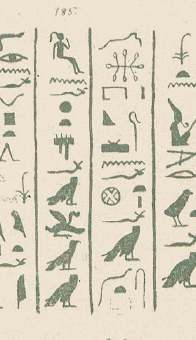
ḥqꜣ.n=f njw.t=f m sḏt, n fḫ.t=f m ṯꜣm
“He ruled in his city as a child, before he was circumcised”
The great inscription in Tomb 3 at Beni Hasan (Khnumhotep II), Dynasty 12.
Hand copy: Beni Hasan I, Newberry (1893), pl. 26; cols. 184–185.
The Imperative
The imperative is a verb form used to express a command, request, instruction, or invitation to act, and is normally addressed to the hearer (second person). It therefore denotes an action to be carried out after the moment of speaking, and usually has no explicit subject, since the performer of the action is clear from the context.
Everyday examples:
English: go!, listen!
In Middle Egyptian:
The imperative addresses the hearer (second person). It is built from the stem alone — with no subject and no personal endings:
There is no distinction between masculine and feminine.
In the plural, plural strokes are sometimes written, and in weak verbs sometimes the ending jj.
A few biliteral verbs take the prefix j.: j.s(j) “go!”, j.ms “bring!”.
3ae-inf. — the stem without the weak consonant (mr, jn); 2ae-gem. — in full or shortened spelling (mꜣꜣ / mꜣ).
A pronominal object appears as a dependent pronoun: jꜥ tw “wash yourself.”
Irregular verbs have special imperatives: jmj “give!” (from rdj), mj “come!” (from jj), j.s(j) “go!”.
Examples:


  |
Hieroglyphs |
| snsn n ḥm=f m jb.w=ṯn | Transliteration |
| “Be friendly (brotherly) toward His Majesty in your hearts” | English |
|---|---|
| “Be brotherly to his majesty in your hearts” | English |
The Passive
The passive is a construction in which the emphasis is not on who performed the action but on who received it.
Everyday examples:
English: The house was built
In Middle Egyptian:
Egyptian has several ways of expressing the passive:
sḏm.tw=f → the ending tw is added to the sḏm=f forms (circumstantial, nominal, prospective): “he is heard,” “may he be heard.”
sḏm(w)=f → a special passive form for the past; the w is rarely written, and there is no gemination: mꜣ(w) “was seen.”
sḏm.n.tw=f → the passive of sḏm.n=f, mainly in the nominal form (in the emphatic sentence).
Stative of a transitive verb → passive state: jw=j ꜣṯp.kw(j) “I am loaded.”
The agent, if expressed, follows jn “by.”
The one who performed the action:
is not mentioned
or is not important
Examples:
 |
Hieroglyphs | Present (sḏm.tw=f) |
| jw mꜣꜣ.tw=sn jn s nb | Transliteration | |
| “They are (always) seen by everyone” | English | |
|---|---|---|
| “They are seen by everyone” | English | |
 |
Hieroglyphs | Past, nominal (sḏm.n.tw=f) |
| rdj.n.tw jnw ḥr mrj.t | Transliteration | |
| “It is on the riverbank that the offerings were placed” | English | |
| “It was on the bank that the gifts were placed” | English | |
 |
Hieroglyphs | Present, nominal (sḏm.tw=f) |
| jrr.tw ḥb-Jmn m Jp.t-s.wt | Transliteration | |
| “It is in Karnak that the feast of Amun is celebrated” | English | |
| “It is in Karnak that the Festival of Amun is celebrated” | English | |
 |
Hieroglyphs | Past (sḏm(w)=f) |
| jw mꜣ(w) ḫ.t jn ḥr nb | Transliteration | |
| “The fire was seen by everyone” | English | |
| “The fire was seen by everyone” | English |
Auxiliary Verbs and Narrative Openers
Auxiliary verbs in Middle Egyptian are verbs that do not chiefly serve to convey the action itself, but rather help build a broader grammatical or narrative meaning. Put simply: one verb “says the main thing,” and another verb “helps frame” what is said.
An example from English:
“It happened that he came”
Here the main point is not really the verb “happened” but the fact that he came. “Happened” merely places the whole event in a certain frame. Such verbs are therefore called auxiliary verbs, because they “help” another construction: they can indicate, for example, that the event is presented as an occurrence, as a new stage in the story, or as something that came to pass.
In Middle Egyptian:
In Middle Egyptian this is especially important, because the meaning of a sentence sometimes rests not on a single simple verb but on an entire construction. Hence some verbs lose some of their original literal meaning and come to function more as grammatical or narrative tools.
Nevertheless, not every verb that appears at the beginning of a sentence is an auxiliary verb. In Middle Egyptian it is worth distinguishing three things:
Auxiliary verb — a verb that helps build the meaning of another construction.
The best example is ḫpr.n when it is used not only in the sense “came into being / happened” but in the sense “it happened that,” “it came to pass that.” Here it does not carry the main content by itself but frames the following event.
Narrative opener — an element that opens a new stage in the story, like “then…,” but requires a particular construction after it. This group
includes mainly:ꜥḥꜥ.n → opens a new stage in the plot and usually precedes an adverbial predicate of verbal origin, such as ꜥḥꜥ.n sḏm.n=f or ꜥḥꜥ.n=f ḥr sḏm. It is a narrative construction that requires an adverbial predicate after it, not just any complement.
wn.jn → usually opens a nonverbal sentence with an adverbial predicate.
Distinction: ꜥḥꜥ.n opens a new development, mostly with a circumstantial verb form or a pseudoverbal construction; wn.jn opens a nonverbal sentence with an adverbial predicate.
Independent narrative form — a form that conveys the event itself rather than merely framing it: sḏm.jn=f “then he heard,” and the construction šm.t pw jr.n=f “then he went.”
Narrative Opener ꜥḥꜥ.n
ꜥḥꜥ.n  is a common narrative opener in Middle Egyptian. In a simple English translation it usually corresponds to “then,” or “then it happened that.” However, it should not be understood as a mere conjunction. It is originally a sḏm.n=f form, without a subject, of the verb ꜥḥꜥ “to stand, to arise,” and therefore it requires an adverbial predicate after it. In Middle Egyptian the construction as a whole marks a new stage in the course of the story — a new development, chronological or logical.
The basic construction: ꜥḥꜥ.n + circumstantial sḏm.n=f.
ꜥḥꜥ.n requires after it an adverbial predicate derived from a verbal root. Therefore several different constructions can follow ꜥḥꜥ.n, as long as they retain an adverbial-verbal character. By contrast, an ordinary prepositional phrase alone is not possible; thus, for example, ꜥḥꜥ.n m pr is not a valid construction in Middle Egyptian.
The main forms and options after ꜥḥꜥ.n:
ꜥḥꜥ.n + sḏm.n=f circumstantial → this is the most common and basic construction.
Examples:
| Hieroglyphs | Transliteration | English |
|---|---|---|
 | ꜥḥꜥ.n sḏm.n=j ḫrw qrj | “Then I heard [the] sound of [the] thunder” |
 | ꜥḥꜥ.n jṯj.n sw msḥ | “Then a crocodile took him” |
ꜥḥꜥ.n + nominal subject + sḏm.n=f circumstantial → sometimes the explicit subject is inserted between ꜥḥꜥ.n and the verb.
Example:
| Hieroglyphs | Transliteration | English |
|---|---|---|
 | ꜥḥꜥ.n Rd-ḏd.t wꜥb.n=s m mw | “Then Ruddjedet purified (herself) with water” |
ꜥḥꜥ.n + sḏm(w)=f passive (past) → the passive circumstantial form is also possible, since it too is an adverbial form.
Examples:
| Hieroglyphs | Transliteration | English |
|---|---|---|
 | ꜥḥꜥ.n msj(.w) n=s ẖrd.w 3 | “Then three sons were born to her” |
 | ꜥḥꜥ.n mꜣ(w) nꜣ n(.jj)kꜣ.wt | “Then these works were inspected” |
ꜥḥꜥ.n + pronoun/noun + ḥr + infinitive → this is a pseudoverbal construction.
Example:
| Hieroglyphs | Transliteration | English |
|---|---|---|
 | ꜥḥꜥ.n=j ḥr jꜣš n mšꜥ | “Then I called to the soldiers” |
ꜥḥꜥ.n + pronoun/noun + stative
Example:
| Hieroglyphs | Transliteration | English |
|---|---|---|
 | ꜥḥꜥ.n dp.t m(w)t.t(j) | “Then [the] boat died (= was wrecked)” |
ꜥḥꜥ.n + stative → a stative form alone is also possible.
Example:
| Hieroglyphs | Transliteration | English |
|---|---|---|
 | ꜥḥꜥ.n hꜣ.kw(j) r mrjj.t | “Then I went down to [the] shore” |
ꜥḥꜥ.n + sḏm=f circumstantial → although the accompanying verb is in the sḏm=f form and not sḏm.n=f, the story is still told in the past.
Example:
| Hieroglyphs | Transliteration | English |
|---|---|---|
 | ꜥḥꜥ.n rdj=f wj m r=f | “Then he placed me in his mouth” |
Narrative Opener wn.jn
wn.jn  is a narrative opener (placed at the head of a sentence) used mainly in narrative literature to introduce a nonverbal sentence with an adverbial predicate. In a simple English translation it usually corresponds to “then,” but it should not be understood as a mere empty introductory particle. Syntactically it presents a state or action as a new stage in the sequence of the story, and it is usually followed by a subject and then an adverbial predicate — often in a pseudoverbal construction.
Everyday examples:
English: Then he was before the king / Then he began building the house
In Middle Egyptian:
There is not necessarily an ordinary past-tense verb here. Often this is a nonverbal sentence placed in a narrative frame by wn.jn. The opener wn.jn does not usually come before an ordinary past verb such as ꜥḥꜥ.n or sḏm.n=f but before a nonverbal construction, such as:
wn.jn + subject + prepositional phrase
wn.jn + subject + ḥr + infinitive
wn.jn + subject + stative
wn.jn + subject + adverb
Example:
  |
Hieroglyphs |
| wn.jn sḫ.tjj pn ḥr rmjj.t ꜥꜣ wr.t | Transliteration |
| “Then this peasant wept very much” | English |
|---|---|
| “Then this peasant was crying very greatly.” | English |
 |
Hieroglyphs |
| wn.jn ḥm=f ḥr pgꜣ sẖꜣ.w | Transliteration |
| “Then His Majesty unrolled [the] writings” | English |
|---|---|
| “Then His Majesty was spreading open the writings.” | English |
Auxiliary Verb ḫpr.n
ḫpr.n  is a form of the verb ḫpr “to come into being, to happen, to occur,” but in Middle Egyptian it can also serve as an auxiliary verb. When it stands at the head of a sentence, it should not always be translated literally as “occurred,” but often as “it happened that,” “it came to pass that.”
The nominal form sḏm.n=f of ḫpr can serve as an auxiliary verb, and like ꜥḥꜥ.n it too does not require an explicit subject.
Everyday examples:
English: It happened that the children went down to the boats / It happened that I was not with them
When ḫpr.n comes before a sentence or before a nominal form, it means “it happened that” (It happened that...): it frames the whole occurrence.
Possible constructions with the auxiliary verb ḫpr.n:
1. ḫpr.n + nonverbal sentence
 |
Hieroglyphs |
| ḫpr.n nn wj ḥnꜥ=sn | Transliteration |
| “It happened that I was not with them” | English |
|---|---|
| “It happened that I was not with them.” | English |
Here ḫpr.n opens the event, followed by a nonverbal sentence.
2. ḫpr.n + sḏm=f (nominal)
 |
Hieroglyphs |
| ḫpr.n hꜣꜣ msw-nsw r dp.tjj | Transliteration |
| “It happened that [the] royal children went down to [the] two boats” | English |
|---|---|
| “It happened that the royal children descended to [the] two boats.” | English |
Here hꜣꜣ is the nominal form (with gemination) of hꜣj “to go down.”
3. In the future: ḫpr + prospective
 |
Hieroglyphs |
| ḫpr js jwd=k r s.t tn | Transliteration |
| “It will happen that you will depart from this place” | English |
|---|---|
| “It shall happen that you will separate yourself from this place.” | English |
 |
Hieroglyphs |
| nn ḫpr jwt ḥꜣ.tjj-ꜥ | Transliteration |
| “It will never happen that [the] nomarch comes” | English |
|---|---|
| “It shall never happen that [the] nomarch comes.” | English |
Compare: ꜥḥꜥ.n opens a new stage in the plot; wn.jn opens a nonverbal sentence; ḫpr.n frames the occurrence — less “then…” and more “and it came to pass that…”.
Independent Narrative Forms
Middle Egyptian has narrative forms and constructions that do not merely open or frame the story but convey the occurrence itself. That is, they do not just say “then” or “it happened that,” but directly present the action that advances the plot.
The auxiliary verbs and narrative openers (ꜥḥꜥ.n, wn.jn, ḫpr.n) provide a frame for the event. By contrast, sḏm.jn=f and the construction šm.t pw jr.n=f convey the event itself: “then he heard,” “then he went.” The construction šm.t pw jr.n=f often opens a new sequence, and the actions that follow it are in sḏm.jn=f.
The sḏm.jn=f Form
The form sḏm.jn=f is a narrative past form used mainly in stories. In a simple English translation it usually corresponds to “then he heard” (e.g., “then he said,” “then he went”). Functionally it is very close to the construction ꜥḥꜥ.n + sḏm.n=f, but not entirely identical to it.
Everyday examples:
English: Then he heard / Then the king said
In Middle Egyptian:
Progress in the story can be expressed by ꜥḥꜥ.n + sḏm.n=f or by sḏm.jn=f. sḏm.jn=f sometimes also has a nuance of consequence — an action resulting from what preceded it — and so it can also be translated “and thereupon.”
The passive form of sḏm.jn=f is sḏm.jn.tw=f.
This form should be distinguished from wn.jn=f, which is used to open nonverbal sentences with an adverbial predicate.
Examples:
 |
Hieroglyphs |
| ḏd.jn ḥm=f ꜥnḫ(.w)-(w)ḏꜣ(.w)-s(nb.w): j.s(j) jn n=j sw | Transliteration |
| “Then His Incarnation, l.p.h., said: ‘Go, bring him for me (to me)’” | English |
|---|---|
| “Then His Incarnation, life, prosperity, health, said: ‘Go, get him for me.’” | English |
 |
Hieroglyphs |
| sꜥq.jn.tw Ḏdj | Transliteration |
| “Then Djedi was brought in” | English |
|---|---|
| “Then, Djedi was brought in.” | English |
 |
Hieroglyphs |
| ḏd.jn Nm.tjj-nḫt pn jr hrw sḫ.tjj | Transliteration |
| “Then Nemtynakht said, ‘Beware, peasant!’” | English |
|---|---|
| “Then Nemti-nekhet said, ‘Beware, peasant!’” | English |
On this wall his autobiography is inscribed, including ḫꜥr.jn ḥm=f r=s mj ꜣbj “then His Majesty raged about it like a panther” (Urk. IV 8,13).
The Construction šm.t pw jr.n=f
The construction šm.t pw jr.n=f is a special narrative construction, found almost only with verbs of motion. Syntactically it is a nominal sentence of the type A pw B.
A → the infinitive of the action
pw → the copula of the nominal sentence
B → the relative form jr.n=f (“what he did”)
In Middle Egyptian:
The construction is found almost only with verbs of motion, and usually opens a new series of events; the actions that follow are often conveyed in sḏm.jn=f. Literally šm.t pw jr.n=f is “what he did was to go,” but the correct translation is simply “he went” or “then he went.” After the opening come the details: who went, where, and with whom.
Breakdown of the construction:
šm.t → infinitive “to go”
pw → connecting copula in a nominal sentence: A “is” B.
jr.n=f → the relative form (past) of the verb jrj “to do”: “(what) he did.”
Examples:
 |
Hieroglyphs |
| wḏꜣ pw jr.n ḥm=f r pr-mḏꜣ.t | Transliteration |
| “Then His Majesty went to the library” (lit.: “what he — His Majesty — did was to go to the library”) | English |
|---|---|
| “So His Majesty went to [the] library.” (lit: “What His Majesty did was proceed to the library”) | English |
 |
Hieroglyphs |
| nꜥj.t pw jr.n=n m ḫd | Transliteration |
| “Then we made [the] voyage, northward” (lit.: “what we did was to sail, northward”) | English |
|---|---|
| “So we made [the] crossing, heading north” (lit: “What we did was ferry, towards north”) | English |
Mutable and Irregular Verbs
Not all Middle Egyptian verbs behave the same way when inflected. Some verbs have a stem that changes in a predictable, regular way — these are the mutable verbs (from the root mutate); and some verbs have forms that do not follow any fixed pattern — these are the irregular verbs.
Mutable Verbs
Mutable verbs are verbs whose stem changes in inflection in a way that is predictable and can be learned as a rule. The student learns the rule — and applies it to all the verbs in the group.
| Type | Group | Feature |
|---|---|---|
| 3-inf | 3ae-inf. | The final weak consonant (j/w) may drop out or go unwritten in certain grammatical forms. In some forms the consonant before the weak consonant is geminated. |
| 4-inf | 4ae-inf. | Four consonants with a weak final consonant (j/w) — behaves like 3ae-inf. |
| 2-gem | 2ae-gem. | The second and third consonants are identical — in some forms only one of them is written (qb versus qbb). |
| 3-gem | 3ae-gem. | The third and fourth consonants are identical — behaves like 2ae-gem. |
Example — mrj “to love” (3ae-inf.):
| Form | Form | Hieroglyphs | Transliteration | Note |
|---|---|---|---|---|
| Circumstantial | Circumstantial |  | mrj | Without gemination |
| Nominal | Nominal |  | mrr | With gemination |
| Prospective | Prospective | ,  | mrj, mrjj | Without gemination, sometimes with jj |
| sḏm.n=f |  | mr.n | The weak consonant is not written | |
| Stative | Stative | | mr | The weak consonant is not written |
| Infinitive | Infinitive |  | mr.t | Ending t |
| Imperative | Imperative | | mr | The weak consonant is not written |
Example — qbb “to be cool” (2ae-gem.):
| Form | Form | Hieroglyphs | Transliteration | Note |
|---|---|---|---|---|
| Circumstantial | Circumstantial |  | qbb | Full spelling |
| Nominal | Nominal | | qbb | Full spelling |
| Prospective | Prospective |  | qb | Without gemination |
| sḏm.n=f |  | qb.n | Without gemination | |
| Stative | Stative | | qb | Without gemination |
| Infinitive | Infinitive | | qbb | Full spelling |
| Imperative | Imperative | , | qbb, qb | Full or shortened spelling |
Irregular Verbs
Irregular verbs are verbs whose forms do not follow any fixed pattern, and each form must be learned separately.
| Root transliteration | Hieroglyphs | English |
|---|---|---|
| rdj |  | “To give” |
| jnj |  | “To bring” |
| mꜣꜣ |  | “To see” |
| wnn |  | “To be” |
| jj / jw |   | “To come” |
Irregular verbs — table of forms:
jj / jw “to come” |
wnn “to be” |
mꜣꜣ “to see” |
jnj “to bring” |
rdj “to give” |
Form | Form |
jw jj |
wn
|
mꜣꜣ  |
jnj
|
dj rdj |
Circumstantial | Circumstantial |
jw
|
wnn
|
mꜣꜣ |
jnn  |
dd
|
Nominal | Nominal |
jwt
|
wn
|
mꜣ  mꜣn mꜣn  |
jnt  |
dj
|
Prospective | Prospective |
jj.n
|
wn.n  |
mꜣ.n |
jn.n |
rdj.n
|
sḏm.n=f | |
jj jw |
wn
|
mꜣ
|
jn
|
rdj dj |
Stative | Stative |
jj.t  jw.t jw.t  |
wnn
|
mꜣꜣ |
jn.t |
rdj.t
|
Infinitive | Infinitive |
mj
|
— | mꜣꜣ
|
jn
|
jmj  |
Imperative | Imperative |











Verb Tables
Strong verb — sḏm “to hear” — active
| Form | Transliteration | English |
|---|---|---|
| Circumstantial after jw (aorist) | jw sḏm=f | “He hears” (generally) |
| Circumstantial, in a clause | sḏm=f | “when he hears” |
| Nominal (emphatic) | sḏm=f + adverbial | “It is … that he hears” |
| Prospective | sḏm=f | “May he hear”, “so that he may hear” |
| Past | jw sḏm.n=f | “He heard” |
| Circumstantial past | sḏm.n=f | “after he had heard” |
| Nominal past (emphatic) | sḏm.n=f + adverbial | “It is … that he heard” |
| sḏm.t=f | n sḏm.t=f | “before he heard” |
| sḏm.jn=f | sḏm.jn=f | “Then he heard” |
| Pseudoverbal | jw=f ḥr sḏm | “He is hearing” |
| Pseudoverbal | jw=f r sḏm | “He is about to hear” |
| Imperative | sḏm | “Hear!” |
| Infinitive | sḏm | “to hear”, “hearing” |
Strong verb — sḏm — passive
| Form | Transliteration | English |
|---|---|---|
| Circumstantial | sḏm.tw=f | “He is heard” |
| Nominal | sḏm.tw=f + adverbial | “It is … that he is heard” |
| Prospective | sḏm.tw=f | “May he be heard” |
| Past | sḏm(w)=f | “He was heard” |
| Nominal past | sḏm.n.tw=f + adverbial | “It is … that he was heard” |
| Stative | jw=f sḏm(.w) | “He is heard” (state) |
3ae-inf. — mrj “to love” — active
| Form | Transliteration | English |
|---|---|---|
| Circumstantial after jw | jw mrj=f | “He loves” (generally) |
| Nominal (emphatic) | mrr=f + adverbial | “It is … that he loves” |
| Prospective | mrj=f, mrjj=f | “May he love” |
| Past | jw mr.n=f | “He loved” |
| Nominal past | mr.n=f + adverbial | “It is … that he loved” |
| Stative | jw=f mr(.w) | “He is loved” (state) |
| Pseudoverbal | jw=f ḥr mr.t | “He is loving” |
| Imperative | mr | “Love!” |
| Infinitive | mr.t | “to love”, “loving” |
3ae-inf. — mrj — passive
| Form | Transliteration | English |
|---|---|---|
| Circumstantial | mrj.tw=f | “He is loved” |
| Nominal | mrr.tw=f + adverbial | “It is … that he is loved” |
| Past | mr(w)=f | “He was loved” |
| Nominal past | mr.n.tw=f + adverbial | “It is … that he was loved” |
2ae-gem. — ẖnn “to disturb” — active
| Form | Transliteration | English |
|---|---|---|
| Circumstantial after jw | jw ẖnn=f | “He disturbs” (generally) |
| Nominal (emphatic) | ẖnn=f + adverbial | “It is … that he disturbs” |
| Prospective | ẖn=f | “May he disturb” |
| Past | jw ẖn.n=f | “He disturbed” |
| Stative | jw=f ẖn(.w) | “He is disturbed” (state) |
| Pseudoverbal | jw=f ḥr ẖnn | “He is disturbing” |
| Imperative | ẖnn, ẖn | “Disturb!” |
| Infinitive | ẖnn | “to disturb” |
2ae-gem. — ẖnn — passive
| Form | Transliteration | English |
|---|---|---|
| Circumstantial | ẖnn.tw=f | “He is disturbed” |
| Prospective | ẖn.tw=f | “May he be disturbed” |
| Past | ẖn(w)=f | “He was disturbed” |
| Nominal past | ẖn.n.tw=f + adverbial | “It is … that he was disturbed” |
Adverb
An adverb is a word or phrase that adds information about the verb: when, where, how, and why the action took place. Whereas an adjective describes a noun, an adverb describes the action itself.
Everyday examples:
Examples: “He walked quickly”, “She wrote there”
In Middle Egyptian:
The adverbial role is usually filled by a prepositional phrase (prepositional phrase) or an expression of place/time (adverbial expressions), and less often than in English by a separate word. There is, however, a small closed set of true adverbs:
| English | Hieroglyphs | Transliteration |
|---|---|---|
| Here |  | ꜥꜣ |
| There, Therein, Therewith, Therefrom |  | jm |
| Today |  | mjn |
| Yesterday |  | m sf |
| Tomorrow |  | m dwꜣw |
| Very |  | wr.t |
| Now, Moreover |  | grt |
| Likewise, Accordingly |  | m.jj |
Some adverbs arise from a preposition combined with a noun, the combination fossilizing into a fixed expression: m sf “yesterday”, m dwꜣw “tomorrow”, r ḏr=f “entirely”, m.jj “likewise”.
Verb → subject → direct object → indirect object / dative → adverb
Because the adverb occupies its natural place at the end of the sentence, it is also the element that receives the emphasis in the nominal (emphatic) sḏm=f — see the chapter on the verb.
An adverb or prepositional phrase is not necessarily a mere adjunct: it can be the predicate itself — this is the adverbial sentence.
Examples (the adverb in red):
| Hieroglyphs | Transliteration | English |
|---|---|---|
 | pr.n=f jm | “He went out from there” |
 | jj.n=j m mjn | “I came today” |
 | jw sḏm=f mdw rꜥ nb | “He hears [a] speech every day” |
 | jw sḏm=j ḥnꜥ s nb | “I hear with everyone” |
To distinguish: two cases in which the marked element is not an adverbial modifier of a verb:
a. The prepositional phrase is the predicate, not an adjunct — this is the adverbial sentence:
 |
Hieroglyphs |
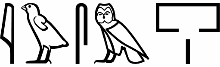
| jw s m pr | Transliteration |
| “[The] man is in [the] house” | English |
|---|---|
| “[The] man [is] in [the] house” | English |
b. The adjunct is a full clause — this is the adverbial clause:
 |
Hieroglyphs |
| jw=f m ršw.t mꜣꜣ sw nsw.t | Transliteration |
| “He is in joy when the king sees him” | English |
|---|---|
| “He [is] in joy when [the] king sees him” | English |
Chapter New Vocabulary
| Hieroglyphs | Transliteration | Type | English |
|---|---|---|---|
 | ꜣbj | Noun | Panther |
 | ꜣbd | Noun | Month |
 | ꜣtp | Verb | To load |
 | jꜣš | Verb | To summon, call |
| jj | Verb | To come |
 | jꜥj | Verb | To wash |
 | jwd | Verb | To separate |
 | Jp.t-s.wt | Proper noun (place) | Karnak |
 | jmj | Imperative | Give! Put! |
 | j.sj | Imperative | Go! |
 | jtj | Noun | Sovereign |
 | jṯj | Verb | To take, carry off |
 | ꜥnn | Verb | To turn back, return |
 | Wꜣs.t | Proper noun (place) | Thebes |
 | wbn | Verb | To rise, shine |
| wnn | Verb | To be, exist |
 | wḫt | Noun | Darkness |
 | bḥs | Verb | To hunt |
 | pr-mḏꜣ.t | Noun | Library |
 | pr.t | Noun | Peret season; procession |
 | pgꜣ | Verb | To open, spread open |
 | fḫ | Verb | To loose, release |
 | mj | Imperative | Come! |
 | mwt | Verb / noun | To die; dead person |
 | m-ḫt | Compound preposition | After |
 | ms | Noun | Child, offspring |
 | msj | Verb | To bear, give birth |
 | msḥ | Noun | Crocodile |
 | mḏꜣ.t | Noun | Papyrus roll |
 | nꜥj | Verb | To travel by boat |
 | Nm.tjj-nḫt | Proper noun | Nemtinakht |
 | rm | Noun | Fish |
 | ršw.t | Noun | Joy |
 | Rd-ḏd.t | Proper noun | Reddjedet |
 | hꜣj | Verb | To descend, come down |
 | ḥꜣ.tjj-ꜥ | Noun | Count, mayor |
 | ḥb | Noun | Festival |
 | ḥmsj | Verb | To sit, dwell |
 | ḥsj | Verb | To praise, favour |
 | ḥsq | Verb | To cut off |
 | ḥqꜣ | Verb | To rule, govern |
 | ḫnms | Noun | Friend |
 | ḫrp | Verb | To control, administer |
 | ḫ.t | Noun | Fire |
 | ḫdj | Verb | To sail downstream |
 | ẖnw | Noun | Royal residence |
 | ẖnn | Verb | To disturb |
 | sꜥq | Verb | To bring in |
 | sw | Noun | Day (in a date) |
 | snb | Noun / verb | Health; to be healthy |
 | snsn | Verb | To fraternize |
 | sḫm | Verb | To have power over |
 | sḫ.tjj | Noun | Farmer, peasant |
 | stp | Verb | To choose |
 | sḏ.tjj | Noun | Child, youth |
 | sḏd | Verb | To relate, tell |
| qbb | Verb | To be cool |
 | qrj | Noun | Thunder, storm-cloud |
 | kꜣ.t | Noun | Work, construction |
 | km | Verb | To complete, amount to |
 | ṯꜣm | Noun | Foreskin |