Negation
Negation
In Middle Egyptian, negation is not symmetrical with the affirmative — the negative form is not necessarily the direct counterpart of the affirmative form. A sentence therefore cannot be negated simply by adding “not”; each type of sentence requires its own negative particle.
Middle Egyptian has several means of negation, each belonging to a particular sentence type or verb form:
| Hieroglyphs | Means of negation | What is negated |
|---|---|---|
 | nn | Adverbial sentence and pseudoverbal construction; future (+ prospective); “without” |
 | n | Verbal sentence: past (n sḏm=f) and present (n sḏm.n=f); a single word |
… | n ... js | Nominal sentence; contrast (“and not”, “but rather”) |
 | m + negatival complement | Imperative (“don’t!”) |
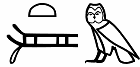 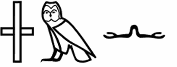 | jmj, tm + negatival complement | Wish, purpose and conditional clauses, nominal forms |
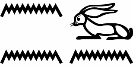 | nn wn | Existence (“there is no”) |
Three points worth keeping in mind throughout the chapter:
1. Egyptian has no universal negative particle. Negation is part of the syntactic structure, not an addition to it — so the table above is not a list of synonyms but a map of constructions.
2. Most negative words are written with the same sign:  , the “arms of negation.” The sign tells you that a negation is involved; only the construction reveals which one.
3. Negation inverts the verb form: the present (jw sḏm=f) is negated precisely with the form that carries .n (n sḏm.n=f), and the past (jw sḏm.n=f) precisely with the form without it (n sḏm=f). This inversion is the source of most errors in this chapter.
Negation of the Adverbial Sentence
The affirmative adverbial sentence usually opens with jw. In the negative, nn replaces jw at the head of the sentence. When the subject is a personal pronoun, a dependent pronoun is used.
The pseudoverbal construction and the stative, which are adverbial sentences, are negated in the same way: nn sw ḥr sḏm “he does not hear.”
Compare:
| Negative form | Affirmative form |
|---|---|
 nn
+ subject + adverbial predicate nn
+ subject + adverbial predicate |
 jw + subject + adverbial predicate jw + subject + adverbial predicate |
Examples:
| Hieroglyphs | Transliteration | English |
|---|---|---|
  | nn mw.t=k ḥnꜥ=k | “Your mother is not with you” |
 | nn sw m s.t=f | “It is not in its place” |
 | nn wj jm | “I am not there” |
nn can also introduce a subordinate clause — only the context decides:
   |
Hieroglyphs |
| jw njtjt=f nn ṯw ḥnꜥ=f | Transliteration |
| “He stammers, [when] you are not with him” | English |
|---|---|
| “He stammers, [when] you are not with him” | English |
Negation of the Verbal Sentence
Negation of the verbal sentence is not symmetrical: the present (jw sḏm=f) is negated with n sḏm.n=f, and the past (jw sḏm.n=f) with n sḏm=f. The future (jw=f r sḏm) is negated with nn + the prospective. This is one of the most confusing points in Egyptian grammar.
Compare:
| Tense | Affirmative | Negative |
|---|---|---|
| Past | jw sḏm.n=f “he heard” | n sḏm=f “he did not hear” |
| Present | jw sḏm=f “he hears” | n sḏm.n=f “he does not hear” |
| Future | jw=f r sḏm “he will hear” | nn sḏm=f “he will not hear” |
| “never” | — | n pꜣ=f sḏm, n sp sḏm=f “he never heard” |
n sḏm.n=f also expresses inability: “he cannot hear.” The n does not mark the past here.
The sḏm=f in n sḏm=f is not the circumstantial sḏm=f: in geminating verbs it has no gemination (n qb=f, n mꜣ=f).
In nn sḏm=f the verb is in the prospective: nn dj=f “he will not give.”
n pꜣ=f sḏm — the verb pꜣ “to have done in the past” + infinitive: “he never heard”.
Examples:
| Hieroglyphs | Transliteration | English |
|---|---|---|
  | n ꜣtp=j ꜥꜣ=j | “I did not load my donkey” |
 | n mr.n=f tꜣ=k | “He does not love your land” |
  | nn msj=s | “She will not give birth” |
| Hieroglyphs | Transliteration | English |
|---|---|---|
 | n sḏm=f | “He did not hear” |
 | n sḏm.n=f | “He does not hear”, “He cannot hear” |
  | nn sḏm=f | “He will not hear” |
 | n pꜣ=f sḏm | “He never heard” |
“Never” also has a dedicated construction of its own: n sp + sḏm=f. In all likelihood sp here is not the noun “occasion, time” but a verb meaning “to happen,” so the literal meaning is “it did not happen that he heard.”
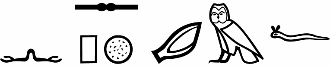 |
Hieroglyphs |
| n sp sḏm=f | Transliteration |
| “he never heard” | English |
|---|---|
| “He never heard” | English |
Both constructions — n sp sḏm=f and n pꜣ=f sḏm — are translated “never.” The difference is subtle: the first negates the very occurrence, while the second negates an action ever having been done before.
Negation of the Nominal Sentence
The nominal sentence is negated with two particles: n before the first element (A) and js after it.
Compare:
| Affirmative form | Negative form |
|---|---|
| A + B | n + A + js + B |
| A + pw + B | n + A + js + pw + B |
Examples:
| Hieroglyphs | Transliteration | English |
|---|---|---|
   | n ntk js s | “You [are] not [a] man” |
  | n rm js pw | “It [is] not [a] fish” |
  | n wr js pw wr jm | “The great one there [is] not [a] great one” |
Rarely, nn appears instead of n: nn sꜣ=k js pw “he is not your son.”
Negation of the Adjectival Sentence
The Egyptians avoided negating a quality and preferred to state the opposite quality (“bad” instead of “not good”). When a quality is nonetheless negated, there are two ways: nn + the adjective, or n + the adjective with .n — like n sḏm.n=f.
Examples:
| Hieroglyphs | Transliteration | English |
|---|---|---|
   | mk nn wr pꜣ t ḥnq.t | “Look, that (amount of) bread and beer is not large” |
  | n nḏm.n n=f bw pn | “He doesn’t find this place pleasant” |
In practice, the normal Egyptian way is not to negate a quality but to replace it with its opposite. Instead of “not good” one says bjn “bad,” and instead of “not large” — nḏs “small.” Negating an adjective is therefore relatively rare, and when it does occur it usually carries emphasis or rhetorical intent.
| Hieroglyphs | The opposite | Hieroglyphs | The quality |
|---|---|---|---|
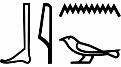 | bjn “bad” |  | nfr “good” |
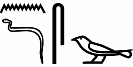 | nḏs “small” | 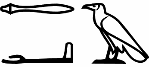 | ꜥꜣ “large” |
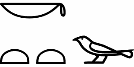 | ktt “few, little” |  | wr “many, much” |
The second way — n + the adjective with .n — derives a verbal form from the adjective and negates it as a verb.
Hence n nḏm.n n=f looks exactly like n sḏm.n=f: it is the same pattern, only the root is an adjective rather than a verb.
Negative Imperative
The negative imperative is a verb form used for commands, instructions, or direct requests not to do or act.
Everyday examples:
Examples: Don’t go!, Don’t listen!
In Middle Egyptian:
m is the imperative of the negative verb jmj “not to do.” It is followed by the negatival complement (Negatival complement) of the verb being prohibited, and together they form a negative imperative (Vetitive): m sḏm(.w) “don’t listen!”
The particle m here is not the preposition m (“in / inside”) — these are two entirely different words written the same way. The context will always make the difference clear.
The negatival complement is a special verb form: the stem + the ending w (before the determinative). The w is hardly ever written, so the complement usually looks like the infinitive — but never with t:
| Meaning | Verb | Hieroglyphs | Infinitive | Hieroglyphs | Negatival complement |
|---|---|---|---|---|---|
| “to remain” | mn |  | mn | | mn.w |
| “to be cool” | qbb |  | qbb | | qbb.w |
| “to do” | jrj |  | jr.t |  | jrj.w |
| “to bring” | jnj |  | jn.t |  | jnj.w |
| “to give” | rdj |  | rdj.t |  | rdj.w |
| “to come” | jj |  | jj.t jw.t |
| jw.w |


The negatival complement is an active verb form and can take an object; a pronoun appears as a dependent pronoun: m snḏ(.w) wj “don’t be afraid of me!”
Examples:
| Hieroglyphs | Transliteration | English |
|---|---|---|
   | m sḏm(.w) | “Don’t listen!” |
 | m rdj(.w) k.t m s.t k.t | “Do not put one thing in place of another” |
 | m snḏ(.w) wj | “Do not fear me!” |
Three constructions not to be confused:
| Meaning | Example | Who | Construction |
|---|---|---|---|
| “don’t listen!” — a command | m sḏm(.w) | The addressee (2nd person) | m + negatival complement |
| “may he not hear” — a wish or instruction | jmj=f sḏm(.w) | Any person | jmj + subject + negatival complement |
| “he will not hear” — future | nn sḏm=f | Any person | nn + prospective |
The difference is not one of strength but of kind: m is a direct command to the addressee, jmj is a wish or instruction in any person, and nn is a factual statement about the future.
Two notes on the negatival complement: in third-weak verbs it ends in j or jj and never in t (jrj(.w), jnj(.w), jj(.w)); and the verb rdj is often written in a shortened spelling, so one finds m dj(.w) alongside m rdj(.w).
The affirmative imperative is the bare verb stem; the negative imperative requires two elements. This is one of the places where negation is not the reverse of the affirmative but an entirely different construction:
| Verb | Affirmative imperative | Negative imperative |
|---|---|---|
| sḏm “to hear” | sḏm “hear!” | m sḏm(.w) “don’t hear!” |
| jrj “to do” | jrj “do!” | m jrj(.w) “don’t do!” |
| rdj “to give” | jmj “give!” | m rdj(.w) “don’t give!” |
Trap: jmj is both the imperative of rdj (“give!”) and the negative verb (“may … not”). Only the construction distinguishes them: the imperative jmj is followed by an object, while the negative verb jmj is followed by a subject and then a negatival complement.
The Negative Verbs tm and jmj
To negate the prospective (in wishes and purpose clauses), the nominal forms, and the infinitive, Egyptian uses the negative verbs jmj and tm “not to do.” The negative verb takes the subject — a suffix pronoun attaches to it — and is followed by the negatival complement, which carries the content of the action. A noun subject usually comes after the negatival complement.
Compare:
| Affirmative form | Negative form | Type |
|---|---|---|
| jw=f r sḏm | nn sḏm=f | Future — main clause |
| sḏm=f (prospective) | jmj=f sḏm(.w) | Wish / instruction — main clause |
| sḏm=f (prospective) | tm=f sḏm(.w) | Purpose / condition — subordinate clause |
1. Simple future: nn + prospective - the particle nn stands at the head of the main clause.
Example:
| Hieroglyphs | Transliteration | English |
|---|---|---|
 | nn sḏm=f | “He will not hear” |
2. Wish and instruction: jmj + negatival complement
Example:
| Hieroglyphs | Transliteration | English |
|---|---|---|
  | jmj=f sḏm(.w) | “May he not hear” |
The example explained:
jmj → “not to do” — the negative verb, in the prospective (wish or instruction)
=f → “he” (3rd person masculine singular suffix pronoun, attached directly to jmj as its subject)
sḏm(.w) → the negatival complement of sḏm “to hear”; it carries the content of the action.
The construction: jmj carries the negation and the wish, sḏm(.w) carries the content of the action. Two elements — one says “not,” the other says “what not to do.”
Another example:
  |
Hieroglyphs |
| jmj=k jwd(.w) jb=k r=j | Transliteration |
| “Do not separate your heart from me” | English |
|---|---|
| “You should not separate your heart from me” | English |
3. Purpose and condition in a subordinate clause: tm + negatival complement
Example:
   |
Hieroglyphs |
| m dbḥ(.w) ḥḏ tm=k swrd(.w) rmṯ | Transliteration |
| “Do not ask for silver, so that you do not exhaust [your] fellow” | English |
|---|---|
| “Don’t ask for money lest you tire [your] companion” | English |
The example explained:
Part one: “Do not ask for silver”
m → “don’t” (negative word for the imperative)
dbḥ(.w) → “to ask” (what must not be done — the negatival complement)
ḥḏ → “silver” (the object)
Part two: “so that you do not exhaust your fellow”
tm=k → “you-not” (the negative auxiliary tm + the subject attached to it)
swrd(.w) → “to exhaust” (what will not happen — the negatival complement)
rmṯ → “fellow” (object)
The idea is simple: each of the two parts has two words working together — one word says “not,” and the other says “what not to do.” The word that says “what not to do” is the negatival complement.
Another example:
  |
Hieroglyphs |
| jw wḏ.n Gb tm=j wnm(.w) ḥs | Transliteration |
| “Geb has commanded that I not eat excrement” | English |
|---|---|
| “Geb ordered that I not eat excrement” | English |
tm also follows jr “if”: jr tm=sn jnj(.w) pꜣ mw nn msj=s “if they do not bring the water, she will not give birth.”
4. Negating the nominal sḏm=f: tm + negatival complement
In the emphatic sentence, the nominal sḏm=f is negated with tm (in its nominal form) + negatival complement; the focus remains on the adverbial adjunct:
 |
Hieroglyphs |
| tm=f ꜣjt(.w) rḫ=f rn=f | Transliteration |
| “It is because he knows his name that he does not grow pale” | English |
|---|---|
| “It is because he knows his name that he does not blanch” | English |
tm inflects like any verb: it takes a suffix pronoun as subject (tm=f, tm=k, tm=sn) and appears in its various forms — circumstantial, nominal, and prospective. All the grammatical marking sits on it, while the main verb always remains in the negatival complement, unchanged.
Negation of the participle and the relative form with tm is discussed in the chapter “Relativity”.
Negation of Existence
Ordinary negation negates an action or state of a known subject — “he did not hear,” “she is not at home.” Negation of existence negates the very existence of the thing — not only that it is not here, but that it does not exist at all. The difference is between “the dog is not in the yard” and “there is no dog.”
Existential construction: jw + wn + noun
Negative existential construction: nn + wn + noun
wn is the circumstantial sḏm=f of wnn “to exist” — an irregular one, since it is not geminated. Often wn is omitted, leaving nn + noun.
Examples:
  |
Hieroglyphs |
| nn wn pḥwj=fj | Transliteration |
| “It has no end” | English |
|---|---|
| “There is no end of it” | English |
 |
Hieroglyphs |
| nn wn js n jsf.tjw | Transliteration |
| “There is no tomb for evildoers” | English |
|---|---|
| “There is no tomb for evildoers” | English |
 |
Hieroglyphs |
| nn bw.t m ẖ.t=j | Transliteration |
| “There is no abomination in my body” | English |
|---|---|
| “There is no abomination in my body” | English |
Negation of Words and Phrases
Besides negating sentences or clauses, Middle Egyptian can also negate individual words or phrases. There are several different constructions for this, depending on the type of word or phrase and on the strength of the negation.
For simple negation, n  is normally used.
Compare:
| Sentence negation | Word negation | Affirmative |
|---|---|---|
 |
 |
 |
| n ḫ.t js pw | n ḫ.t pw | ḫ.t pw |
| “It is not a thing” | “It is a non-thing” (“it is nothing”) | “It is a thing” |
| “It is not a thing” | “It is a not-thing” (“It is nothing”) | “It is a thing” |
When a word or phrase stands in contrast to another word or phrase, Middle Egyptian uses the negation n+js. This negation can usually be translated “[and] not,” “but not,” or “but rather.”
Examples:
   |
Hieroglyphs |
| nḏs n js mjtw=k | Transliteration |
| “A common man, not worth you” | English |
|---|---|
| “[A] commoner, not your equal” | English |
  |
Hieroglyphs |
| m mꜣꜥ.t n js m grg | Transliteration |
| “In truth, [and] not in falsehood” | English |
|---|---|
| “In truth, not in falsehood” | English |
To express “without …” nn  is normally used.
Example:
   |
Hieroglyphs |
| jw ḏꜣj.n=j m dp.t nn ḥmw=s | Transliteration |
| “I crossed in a boat without its steering oar” | English |
|---|---|
| “I crossed over in [a] boat without its steering oar.” | English |
Instead of a noun, an infinitive can be placed after the negation.
Examples:
   |
Hieroglyphs |
| jw ḫdj.n nsw nn rdj.t rḫ st mšꜥ=f | Transliteration |
| “The king sailed north without informing his army” | English |
|---|---|
| “The king sailed north without letting his army know” | English |
  |
Hieroglyphs |
| jw=f m-bꜣḥ ḥꜣ.tjj-ꜥ nn sbṯ m=f | Transliteration |
| “He stood before the nomarch without laughing at him” | English |
|---|---|
| “He was before the nomarch without laughing at him” | English |
Summary
| Affirmative | Negative | Example |
|---|---|---|
| jw + subject + adverbial predicate | nn + subject + adverbial predicate | “Your mother is not with you” |
| jw sḏm.n=f | n sḏm=f | “he did not hear” |
| jw sḏm=f | n sḏm.n=f | “he does not hear” |
| jw=f r sḏm | nn sḏm=f | “he will not hear” |
| A B | n A js B | “You are not a man” |
| sḏm | m sḏm(.w) | “Don’t listen!” |
| sḏm=f (prospective) | jmj=f sḏm(.w) | “May he not hear” |
| sḏm=f (prospective) | tm=f sḏm(.w) | “So that he does not hear” |
| jw wn js | nn wn js | “There is no tomb” |
| sḏm.n=f | n sp sḏm=f | “he never heard” |
| ḫ.t pw | n ḫ.t pw | “It is a non-thing” |
| — | nn ḥmw | “Without an oar” |
Chapter New Vocabulary
| Hieroglyphs | Transliteration | Type | English |
|---|---|---|---|
 | ꜣjt | Verb | To blanch, turn pale |
 | jmj | Verb | Negative verb "not to do" |
 | jsf.t | Noun | Wrongdoing, chaos |
 | wrd | Verb | To tire, be weary |
 | wḏ | Verb / noun | To command; decree |
 | bw.t | Noun | Abomination |
 | pꜣ | Verb | Auxiliary verb, "did formerly" |
 | pḥwj | Noun | End |
 | mꜣꜥ.t | Noun | Maat: truth, justice |
 | njtjt | Verb | To stutter |
 | ḥmw | Noun | Steering oar |
 | ḥs | Noun | Excrement |
 | ẖ.t | Noun | Belly, body |
 | swrd | Verb | To make tired |
 | sp | Noun | Time, occasion |
 | grg | Noun / verb | Falsehood; to found |
 | dbḥ | Verb | To ask, beg |
 | ḏꜣj | Verb | To cross, ferry |