Relativity
Relativity
Relativity is the way a language adds information about a noun already mentioned. Put simply, it is the mechanism by which one says not only “the man,” but “the man who is in the house,” “the man I heard about,” or “the man whose wife is in the city.” Syntactically, relativity links a preceding noun, called the antecedent, with a descriptive unit that follows and clarifies it. A relative clause does not constitute an independent sentence.
In Middle Egyptian there is no single fixed relative word like English “who” or “that.” Relativity is expressed in several ways: sometimes with an explicit relative pronoun (nt.jj), and sometimes with no marker at all — by a circumstantial clause, a participle, or a relative form of the verb. One must therefore know all the ways and identify which one is in use in each sentence.
It is also important to distinguish relativity from possession. Possession concerns a relationship of ownership or connection, such as “the king’s house,” whereas relativity concerns describing a noun by means of a clause or a clause-like construction. The two areas do sometimes meet, for example in sentences such as “the man whose wife is in the house,” but they are not the same thing.
The main means of relativity, in the order of this chapter:
Virtual relative clause (without a relative marker)
Relative clause introduced by the relative pronoun nt.jj
The negative relative pronoun jwt.jj
The participle (Participle)
The relative forms (Relative forms)
Noun clause with nt.t “that”
Relative Clause
A relative clause is a clause that serves as a modifier of a noun mentioned before it, providing clarifying information about it. The noun described is called the antecedent. Syntactically, the relative clause functions like an adjective: it usually does not advance the main narrative but describes, identifies, or specifies the antecedent. The tense in the relative clause is determined relative to the tense of the main verb of the sentence, while the aspect may vary.
Everyday examples:
Examples: The man who came, The house that I built, The words that were heard
In Middle Egyptian:
In Middle Egyptian the relative clause is syntactically simpler than in English. When the antecedent is not the subject of the clause, there is an element within the clause that refers back to it; this element is called a resumptive pronoun or resumptive adverb. Sometimes it is the subject of the clause, and sometimes it is not the subject but an object, the object of a preposition, or a possessive element.
Direct and Indirect Relativity
In relative clauses one can distinguish between direct and indirect relativity. In direct relativity, the antecedent is also the subject of the relative clause. That is, the clause describes the antecedent itself directly. In indirect relativity, by contrast, the antecedent is not the subject of the clause but is connected to it in another way — for example as an object, as the object of a preposition, or as a possessor. For this reason, indirect relativity usually requires within the clause a resumptive element, such as a suffix pronoun or a resumptive adverb, that links the clause back to the antecedent.
Everyday examples:
| Relative | English | Explanation |
|---|---|---|
| Direct | “The man who stood at the door greeted me.” | The antecedent is the man, and he is also the subject of the relative clause “stood at the door”. |
| Direct | “The book that you read is lying on the table.” | The antecedent is the book, and it is what the clause “that you read” refers to directly. |
| Indirect | “The man whose wife went to Haifa stayed home.” | The antecedent is the man, but the subject of the relative clause is “his wife,” not the man himself. |
| Indirect | “The house whose roof collapsed was evacuated of its residents.” | The antecedent is the house, but inside the relative clause what is said directly concerns “its roof,” not the house itself. |
Examples of a direct relative clause:
| Hieroglyphs | Transliteration | English |
|---|---|---|
  | ẖnt(j)=f nt.jj m ḥw.t-nṯr | “his statue, which is in the temple” |
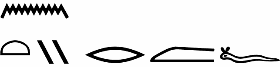  | sr.w nt.jj r-gs=f | “[the] officials who [were] beside him” |
In the first example the relation is direct, since the statue itself is in the temple. In the second, the antecedent sr.w is itself the subject of the relative clause — they are the ones who were beside him. The suffix pronoun =f inside the clause does not refer back to the antecedent but to the king, so there is no resumptive pronoun here and the relation remains direct.
Note: the antecedent sr.w is plural, but the relative word is written in the singular form nt.jj and not nt.jjw.
| Hieroglyphs | Transliteration | English |
|---|---|---|
  | s nt.jj mr.wt m ẖ.t=f | “the man who has pains in his belly” |
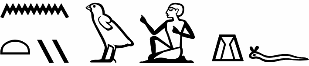 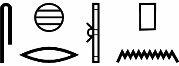 | sḫr pn nt.jj wj ẖr=f | “this situation in which I was” |
In the first example the relation is indirect, since the subject of the clause is “pains,” and the pronoun =f in ẖ.t=f “his belly” refers back to “the man.” In the second, the subject of the clause is the dependent pronoun wj (“I”), while the antecedent sḫr pn is represented inside the clause by the resumptive pronoun =f in ẖr=f. Literally: “this situation which I am under it.”
Virtual Relative Clause
A virtual relative clause is a relative clause that follows the noun it describes without an explicit relative word such as nt.jj. The relation exists, but it is not marked by a separate relative pronoun; hence it is called “virtual.”
In Middle Egyptian:
In a virtual relative clause, the antecedent noun comes first, followed by a clause that describes it directly. A virtual relative clause has no explicit relative word, but the relative link is understood from the structure itself. Various kinds of descriptive clauses can serve as virtual relative clauses, such as a nonverbal clause, an adverbial clause, or a circumstantial clause.
A. Examples of a direct virtual relative clause (the antecedent is also the subject of the descriptive clause):
| Hieroglyphs |  | Type of descriptive clause |
| Transliteration | jw rḫ.n=j nḏs ḥmsj=f m Ḏd-Snfrw | Verbal-circumstantial, in the form sḏm=f |
| English | “I have heard (lit. I know) of a commoner who lives in Djed-Sneferu.” | |
|---|---|---|
| English | “I have learned of [a] commoner who dwells in Djed-Snofru.” |
| Hieroglyphs | Transliteration | English |
|---|---|---|
 | srt jw=s m ḥꜥw | “a thorn that is in the flesh” |
B. Examples of an indirect virtual relative clause (the antecedent is not the subject of the relative clause, so the clause refers back to it through another element):
| Hieroglyphs |  | Type of descriptive clause |
| Transliteration | jw ms.n=j n=f jnw jn.n sw mšꜥ m Wꜣwꜣ.t | Verbal-circumstantial, in the form sḏm.n=f |
| English | “I presented to him tribute [that] the army had brought from Wawat.” | |
|---|---|---|
| English | “I presented to him tribute that [the] army had brought back from Wawat.” |
| Hieroglyphs |  | Type of descriptive clause |
| Transliteration | jw mꜣ.n=n dp.t nbw jm=s jw=n m Kꜣš | Adverbial |
| English | “We saw a boat that had gold in it when we were in Kush.” | |
|---|---|---|
| English | “We saw [a] boat in which there was gold while we were in Kush” |
| Hieroglyphs |  | Type of descriptive clause |
| Transliteration | jw rḫ.n=j ḥm.t Nfr.t rn=s | Nominal |
| English | “I have heard (lit. I know) of a woman [whose] name is Nefret.” | |
|---|---|---|
| English | “I have learned of [a] woman whose name is Nofret.” |
| Hieroglyphs |  | Type of descriptive clause |
| Transliteration | sr pw ꜥꜣ n=f ḫ.t | Nonverbal (nominal-adjectival) |
| English | “He was a nobleman [who] had much property.” | |
|---|---|---|
| English | “He was [a] noble [who] had much property.” |
| Hieroglyphs | Transliteration | English |
|---|---|---|
 | nḏs Ḏdj rn=f | “a gentleman [whose] name is Djedi” |
| Hieroglyphs | Transliteration | English |
|---|---|---|
 | wsḫ.t nn ḥmw=s | “a boat [that] has no rudder” |
In this example the clause itself is negative (nn), and the pronoun =s refers back to the boat.
The Relative Adjective nt.jj
When the antecedent is defined, Middle Egyptian tends to introduce the
relative clause with the relative pronoun nt.jj  . This form
explicitly marks the following unit as describing the preceding noun, so it is generally equivalent
to “who / that / which.” However,
nt.jj is not merely a marker introducing a relative
clause; sometimes it also stands alone in a nominal use, that is, as a substitute for a
noun.
. This form
explicitly marks the following unit as describing the preceding noun, so it is generally equivalent
to “who / that / which.” However,
nt.jj is not merely a marker introducing a relative
clause; sometimes it also stands alone in a nominal use, that is, as a substitute for a
noun.
Everyday examples:
For example: The book that I bought, The girl who lives next door
In Middle Egyptian:
Grammatically, nt.jj is a relative adjective, derived by the nisba formation, and therefore it agrees in gender and number with the antecedent it describes. However, the masculine singular sometimes appears in place of the other forms. The basic forms are:
| Hieroglyphs | Transliteration | Gender and number |
|---|---|---|
| nt.jj | Masculine singular |
 | nt(.jj)t | Feminine singular |
 | nt.jjw | Masculine plural |
| nt(.jjw)t | Feminine plural |
After nt.jj there usually comes an adverbial predicate: an adverb, a prepositional phrase , or a stative.
a. nt.jj + adverb / prepositional phrase
Example (antecedent in red, adverbial predicate in blue):
| Hieroglyphs | Transliteration | English |
|---|---|---|
   | sqd pn nt.jj ꜥꜣ | “this sailor who (is) here” |
Here the type of clause: adverbial with an adverb. Type of relation: direct.
| Hieroglyphs | Transliteration | Translation |
|---|---|---|
  | pr=f nt.jj m njw.t | “his house which is in the town” |
  | s nt.jj m pr | “[the] man who is in the house” |
Here the types of clause: adverbial with a prepositional phrase . Type of relation: direct.
    |
Hieroglyphs |
| nṯr.w nb.w nt.jjw m p.t nt.jjw ḥr tꜣ | Transliteration |
| “all [the] gods who are in heaven [and] who are on [the] earth” | English |
|---|---|
| “all [the] gods who are in heaven and who are on earth” | English |
Here the type of clause: adverbial, in two parallel clauses. Type of relation: direct.
nt.jj agrees with the antecedent in gender and number:
   |
Hieroglyphs |
| ḥnw.t-tꜣ nt(.jj)t m ꜥḥ=f | Transliteration |
| “the mistress of the land, who is in his palace” | English |
|---|---|
| “the land’s mistress, who is in his palace” | English |
  |
Hieroglyphs |
| wsḫ(.t) nt.jj sꜣ-nsw Ḥr-dd=f jm=f | Transliteration |
| “[the] barge in which the king's son Hordedef was” | English |
|---|---|
| “[the] barge in which King’s Son Hardedef was” | English |
Here the type of clause: adverbial with a prepositional phrase . Type of relation: indirect.
  |
Hieroglyphs |
| jr nṯr pn nt.jj ḥr=f m ṯsm | Transliteration |
| “as for this god, whose face is like the face of a dog” | English |
|---|---|
| “as to this god whose face [is like that] of [a] dog” | English |
Here the type of clause: nominal. Type of relation: indirect.
A pronominal subject:
When the subject of the clause is a personal pronoun, it appears as a suffix pronoun on nt.jj (nt.jj=f, nt.jj=sn). In the first person singular and with st “it” a dependent pronoun is used (nt.jj wj, nt.jj st):
| Hieroglyphs | Transliteration | English |
|---|---|---|
 | bw nt.jj=f jm | “[the] place in which he is” |
 | bw nt.jj st jm | “[the] place in which it was” |
b. nt.jj + stative
One of the usual predicates after nt.jj is the stative. In such a case the relative clause describes the antecedent as being in a certain state.
Examples (antecedent in red, stative predicate in blue):
| Hieroglyphs | Transliteration | English |
|---|---|---|
  | sn.t=n nt(.jj)t nfr.tj | “our sister who is fortunate” |
  | ꜥ.t nb.t n(.jj)t s nt.jj mr.w | “every limb of a person who is ill” |
c. nt.jj used as a noun, without an explicit antecedent:
| Hieroglyphs | Transliteration | English |
|---|---|---|
 | nt.jj ḥnꜥ=f | “[the] one who [is/was] with him” |
   | mj nt.jj m mr=f | “like one who is in his pyramid” |
  | ḥnꜥ nt(.jj)t nb.t jm=f | “together with everything that is in it” |
nt.jj nb “everyone who….” The expression nt(.jj)t jwt(.jj)t “what is and what is not” means “everything whatsoever.”
D. nt.jj + verbal clause
A verbal clause can also follow nt.jj; when the antecedent is not the subject, the clause contains a resumptive pronoun:
   |
Hieroglyphs |
|
Transliteration |
| “this boat that I gave you” | English |
|---|---|
| “this boat that I have given to you” | English |
E. nt.jj + negative sentence
In Middle Egyptian a negative relative clause is usually built with nt.jj + a negative sentence. When the relation is direct, the subject appears as a separate pronoun:
  |
Hieroglyphs |
|
Transliteration |
| “what was not in it” | English |
|---|---|
| “that which was not inside it” | English |
The negative relative pronoun jwt.jj (below) is an older form, and it survived in Middle Egyptian only in certain uses.
 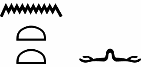 |
Hieroglyphs |
|
Transliteration |
| “what has not yet come” | English |
|---|---|
| “that which has not yet come” | English |
Negation in a relative clause is not limited to nn. Here a verb form is negated — n sḏm.t=f — so no separate pronoun is needed: the subject of jj.t is the relative word itself. A separate pronoun is required only when what is negated is an nn sentence (an adverbial sentence or a sentence of existence), which must have an explicit subject — like st in the previous example.
Resumptive Pronoun and Resumptive Adverb
When the antecedent is not the subject of the clause, the resumptive element can be a suffix pronoun or a resumptive adverb, such as jm or jm=s .
As a rule, the preposition m  becomes jm
  before a suffix
pronoun.
before a suffix
pronoun.
m → “in…”
jm=f → “in him / in it”
jm=s → “in her / in it”
jm=sn → “in them”
It is also important to distinguish between two situations:
A. jm before a suffix pronoun → this is the morphological rule:
m + =f → jm=f
m + =s → jm=s
b. jm as an independent adverb
Sometimes jm also appears without a pronoun, meaning “there,” “thither,” “in it,” “from it,” according to context.
Examples (relative clause in bold, suffix pronoun in red, resumptive adverb in blue):
| Hieroglyphs | Transliteration | English |
|---|---|---|
  | dp.t nbw jm=s | “a boat in which there was gold” |
Here this is an indirect virtual relative clause, and the clause itself is adverbial. The resumptive element is the resumptive adverb jm=s.
   | s nt.jj ḥm.t=f m pr | “[the] man whose wife is in the house” |
Here this is an indirect adverbial relative clause. The resumptive element is the suffix pronoun f.
  | bw nt.jj nṯr.w jm | “[the] place where [the] gods are” |
Here this is an indirect adverbial relative clause because:
The antecedent is bw “place,” but the subject of the clause is nṯr.w “[the] gods”
The predicate is the adverb of place jm “there,” which functions as a resumptive adverb.
The Negative Relative Adjective jwt.jj
The negative relative pronoun jwt.jj  is the negative
counterpart of nt.jj . Its basic
meaning is: “which is not,” “who has not,” “one who is not,” “that
which is not.”
is the negative
counterpart of nt.jj . Its basic
meaning is: “which is not,” “who has not,” “one who is not,” “that
which is not.”
Everyday examples:
For example: One who has nothing, The god who has no equal
In Middle Egyptian:
Like nt.jj, jwt.jj too can appear in two main uses:
1. As a relative pronoun introducing a relative clause
In this case it follows an antecedent, usually a defined one, and introduces a negative relative clause. If the antecedent is not the subject of the clause, a resumptive pronoun is needed.
2. As a noun substitute (substantival use)
In this case there is no explicit antecedent before it, and it itself means: “... one who has not,” “... the one who is not,” “... a person who has not”
Basic forms:
| Hieroglyphs | Transliteration | Gender and number |
|---|---|---|
 | jwt.jj | Masculine singular |
 | jwt.(jj)t | Feminine singular |
 | jwt.jjw | Masculine plural |
| jwt.(jjw)t | Feminine plural |
Common uses:
jwt.jj introducing a relative clause
jwt.jj in nominal use
jwt.jj + noun — “without, lacking”
jwt.jj + adverbial expression
A. jwt.jj introducing a relative clause - here jwt.jj follows an explicit antecedent and introduces a negative relative clause.
Examples:
  |
Hieroglyphs |
| jnk nṯr ꜥꜣ jwt.jj snw=f | Transliteration |
| “I am [the] great god who has no equal” | English |
|---|---|
| “I [am the] great god who has no equal” | English |
Here the type of clause: nominal, with a negative relative link. Here jwt.jj introduces a relative clause describing nṯr ꜥꜣ (“the great god”), and there is also a resumptive pronoun f referring back to “the great god.”
 |
Hieroglyphs |
| ḥꜣt.t tn jwt.(jj)t rḫ nṯr.w rn=s | Transliteration |
| “this bow-rope, whose name [the] gods do not know” | English |
|---|---|
| “that bow cable whose name [the] gods do not know” | English |
Here the type of clause: verbal with a negative relative link. Here jwt.(jj)t (feminine) introduces a negative relative clause after an explicit antecedent (ḥꜣt.t tn, “this bow-rope,” a feminine noun), and inside the clause there is a resumptive pronoun s.
B. jwt.jj in nominal use - here there is no explicit antecedent before jwt.jj; it stands alone in nominal use.
When jwt.jj stands
alone, without an explicit antecedent before it, it serves as a pronoun or a noun
meaning:
“one who has not,” “a person lacking ...,” “a poor man / destitute,” according to
context.
Examples:
| Hieroglyphs | Transliteration | English |
|---|---|---|
 | jwt.jj n=f | “one who has nothing” |
 | jwt.jj ḥm.t=f | “he that does not have [a] wife” |
C. jwt.jj + noun “without / lacking” - here jwt.jj forms a phrase of the type “without X,” “lacking X,” “in which there is no X.”
Example:
| Hieroglyphs | Transliteration | English |
|---|---|---|
 | mḏꜣ.t jwt.(jj)t sš | “[a] papyrus without writing” |
Literally: “a scroll whose writing is not” — jwt.jj + noun, the relative counterpart of nn + noun.
See this complex example:
| ||
| ntk jt n(.jj) nmḥ, hj n(.jj) ḫꜣr.t, sn n(.jj) wḏꜥ.t, šnd.jjt n(.jj)t jwt(.jj)w mw.t=f | ||
| “You are a father to the orphan, a husband to the widow, a brother to the divorced woman, the apron of one who has no mother” | ||
|---|---|---|
| Transliteration of clause | English | Analysis |
| jt n(.jj) nmḥ | “a father to the orphan” | Noun phrase with indirect genitive (n.jj) |
| hj n(.jj) ḫꜣr.t | “a husband to the widow” | Noun phrase with indirect genitive (n.jj) |
| sn n(.jj) wḏꜥ.t | “a brother to the divorced woman” | Noun phrase with indirect genitive (n.jj) |
Noun phrase šnd.jjt n(.jj)t jwt(.jj)w mw.t=f Negative nominal relative clause | “the apron of one who has no mother” | Noun phrase in the indirect genitive (n.jj) Within the phrase there is a nominal use of the negative relative pronoun jwt.jj There is no explicit antecedent here before jwt(.jj)w “one who has no ...” (the plural form .jjw denotes “all who…”) |




D. jwt.jj + adverbial expression - here jwt.jj introduces a negative clause or phrase with an adverbial predicate.
Example:
 |
Hieroglyphs |
| jꜣ.t tw.jj n(.jj)t ꜣḫw jwt.(jj)t sqdw ḥr=s | Transliteration |
| “that hill of [the] winds on which there are no travelers” (lit. “which there are no travelers on it”) | English |
|---|---|
| “that mound of [the] spirits upon which there are no travellers” (literally: “that there are no travellers upon it”) | English |
Here jwt.jj comes with the adverbial expression ḥr=s (“on it”).
 |
Hieroglyphs |
| rdj.n=j (j)ḫ.t n jwt.jj sw | Transliteration |
| “I gave things to one who was not” (i.e., to the poor, the destitute) | English |
|---|---|
| “I gave things to the one who is nothing” (i.e. to the pauper) | English |
Here the predicate after jwt.jj is the dependent pronoun sw. The analysis of the construction is disputed: Gardiner derives it from nn sw “he is not,” Hoch sees sw as the subject of jwt.jj, and Allen notes that the syntax has not yet been properly explained.
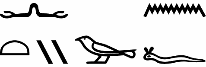 |
Hieroglyphs |
| jwt.jj n=f | Transliteration |
| “one who has not (anything)” — a poor man, destitute | English |
|---|---|
| “one who has nothing” | English |
The predicate here is the prepositional expression n=f, and the subject — ḫ.t “things” — remains unexpressed. This is why Gardiner assigns this expression to the present section, even though we met it in section B as a noun substitute.
The Participle
The participle is a verb form that describes a noun — one who performs an action, or one on whom an action was performed. Unlike a conjugated verb, the participle does not state a fact; it describes. Like an adjective, the participle agrees in gender and number with the noun it describes.
The participle is a non-conjugated form: it does not mark person, and it is always part of a noun phrase — unless it is used in the participial statement (see below).
Examples:
English: the writing man, the seated woman
These are not complete sentences, but descriptions.
In Middle Egyptian:
The participle is used for:
describing a person, object, state, or quality
building relative constructions
There are five participles: four differ in aspect (perfective / imperfective) and in voice (active / passive), and the fifth is the prospective participle:
Imperfective active — “the one who does” (habitually, repeatedly); third-weak and geminated verbs show gemination.
Imperfective passive — “the one to whom it is done” (habitually); with gemination, and in the masculine singular the ending w.
Perfective active — “the one who did” (a single action, usually in the past); no gemination.
Perfective passive — “the one to whom it was done” (single occurrence); no gemination, and in the masculine singular the ending w or j.
Prospective — “the one who will do,” a possible or expected action: sḏm.tj=fj “one who will hear” (almost always active).
The participle forms (illustrated with the verb mrj “to love”):
| Participle | Transliteration | Meaning |
|---|---|---|
| Imperfective active | mrr(.j) | “the one who loves” (habitually) |
| Imperfective passive | mrr.w | “the beloved” (habitually) |
| Perfective active | mrj | “the one who loved” |
| Perfective passive | mrj.j, mrj.w | “the one who was loved” |
| Prospective | mr.tj=fj | “the one who will love” |
In a strong verb (sḏm) the imperfective and perfective look identical, and context decides. The participle agrees in gender and number with the noun it describes: sꜣ ḏd ḥr=s “the son who spoke about it,” sꜣ.t ḏd.t ḥr=s “the daughter who spoke about it.”
Three ways of using the participle:
1. As an adjective (attributive) — the participle follows the noun and agrees with it in gender and number:
| Hieroglyphs | Transliteration | English |
|---|---|---|
 | sꜣ sḏm.w | “an obedient son” (lit. “a son who hears”) |
 | nṯr.w wnn.jw m šms=f | “[the] gods who are (always) in his following” |
 | nfr.t nb.t jn.jt n ḥm n nb=j | “every good thing that was brought to the Majesty of my lord” |
2. As a noun (substantival) — the participle stands alone: “the one who….” This is also how names of professions are formed:
| Hieroglyphs | Transliteration | English |
|---|---|---|
 | sḏm.j | “judge” (lit. “one who hears”) |
 | ḏd.t mꜣꜥ.t | “she who speaks [the] truth” |
 | mꜣꜣ.w m p.t | “he who [is] seen in [the] sky” |
3. As the predicate of an adjectival sentence — only the perfective participle, at the head of the sentence, in the masculine singular; a pronominal subject appears as a dependent pronoun:
| Hieroglyphs | Transliteration | English |
|---|---|---|
  | sḥḏ.w sw tꜣ.wj r jtn | “He illuminates the Two Lands more than the sun” |
Agreement in gender and number (perfective active participle of ḏd):
| Transliteration | English |
|---|---|
| sꜣ ḏd ḥr=s | “[the] son who spoke about it” |
| sꜣ.w ḏd.w ḥr=s | “[the] sons who spoke about it” |
| sꜣ.t ḏd.t ḥr=s | “[the] daughter who spoke about it” |
| sꜣ.wt ḏd.(w)t ḥr=s | “[the] daughters who spoke about it” |
Active Participle
The active participle is a verb form that describes the one who performs the action — not the one who receives it, nor a statement that the action took place, but simply a description of the agent.
The active participle answers the question: who is this? → the one who does X.
Examples:
| Hieroglyphs | Transliteration | English |
|---|---|---|
 | s sḏm | “[The] listening man” |
 | s sḏm mdw | “[The] man that listens to [the] speech” |
 | ḥm.t sḏm.t | “[The] listening woman” |
| Hieroglyphs | Transliteration | English |
|---|---|---|
 | s jrj sw | “[the] man who made it” |
 | sꜣ mr.tj=fj | “[the] son who will love” |
 |
Hieroglyphs |
| sn ḫdd.j r ẖnw | Transliteration |
| “a brother who habitually sails north to the residence” | English |
|---|---|
| “[a] brother who (regularly) travels north to [the] Residence” | English |
 |
Hieroglyphs |
| sr.w sḏm.tj=sn | Transliteration |
| “the officials who will hear” | English |
|---|---|
| “[the] officials who will hear” | English |
ḫdd.j — imperfective participle (with gemination): a repeated action. sḏm.tj=sn — prospective participle: an expected action.
Passive Participle
The passive participle describes who or what the action was performed on — not who did it, but who or what received it.
Everyday examples:
English: the beloved man, the heard thing, the given land
The passive participle answers the question: who or what is this? → the one on whom the action was performed.
Examples:
| Transliteration | English |
|---|---|
| nbw dd.w | “[the] given gold” |
| ḥnq.t dd.wt | “[the] given beer” |
| s mrr.w | “[the] beloved man” |
Passive participle with an object
A passive participle can take a complement, and then it describes the antecedent indirectly, with a resumptive pronoun or adverb: “the place in which the coffin was made.”
| Hieroglyphs | Transliteration | English |
|---|---|---|
 | bw jrj.w wj jm | “[the] place in which [the] coffin was made” |
 | s.t msj.t sꜣ=s | “[the] woman whose son was born” |
 | Jn-jt=f ḏd.w n=f Jw-snb | “Intef, [the one] called Iusenb” |
A fixed phrase after the king's name: dj ꜥnḫ ḏ.t “(one) given life forever” — perfective passive participle of rdj.
Passive participle + noun
In laudatory inscriptions the passive participle stands in a genitive with a noun — “beloved of…”:
| Hieroglyphs | Transliteration | English |
|---|---|---|
 | mrr.w nb=f | “[the] beloved of his lord” |
 | ḥss(.jj) n(.jj) jt=f | “[the] one praised by his father” |
The Participial Statement (Cleft Sentence)
The participial statement emphasizes the performer of the action: “it is his brother who gave it to him.” It is built from jn + noun (the emphasized element) + active participle. When the emphasized element is a personal pronoun, an independent pronoun is used without jn: jnk sḏm “it is I who hear.”
| Element | Content |
|---|---|
| A | The particle jn + noun or noun phrase |
| B | Perfective or imperfective active participle — always masculine singular, regardless of the gender or number of A |
This is an emphatic construction: A is always emphasized. The best translation is usually a relative clause.
Examples:
   |
Hieroglyphs |
| jn sn=f dd(.j) n=f st | Transliteration |
| “it is his brother who used to give it to him” | English |
|---|---|
| “It is his brother who used to give it to him” | English |
  |
Hieroglyphs |
| jn nṯr jrj ṯn | Transliteration |
| “it is [the] god who made you” | English |
|---|---|
| “It is [the] god who made you” | English |
Imperfective participle (dd) — repeated action: “who used to give”; perfective participle (jrj) — single action: “who made.” To express the future, the prospective is used instead of the participle: jn + noun + sḏm=f.
The interrogative m “who?” also appears in this construction: jn m, and in later spelling n-m:
| Hieroglyphs | Transliteration | English |
|---|---|---|
 | jn m rf jrr st | “Who is doing this?” |
 | n-m jn tw nḏs | “Who brought you, little man?” |
Negation of the Participle
The participle is negated with the negative verb tm “not to do”: tm appears in the required participle form, followed by the negative complement. In the perfective passive participle tm is geminated: tmm.
 |
Hieroglyphs |
| jn jb sḫpr nb=f m sḏm m tm sḏm(.w) | Transliteration |
| “[The] heart is what makes its owner one who hears or one who does not hear” | English |
|---|---|
| “It is [the] heart that turns its owner into one who listens or one who does not listen” | English |
 |
Hieroglyphs |
| jw=j rḫ.kw(j) tmm mꜣꜣ(.w) | Transliteration |
| “I know the one who is not seen” | English |
|---|---|
| “I am one who knows him who is not seen” | English |
The relative form (next section) is also negated with tm: nn s.t nb.t tm.t.n=j jrj(.w) mnw jm=s “there is no place in which I did not make monuments”.
Relative Forms
The relative form is a verb form that functions as an adjective (or as a noun), but — unlike the participle — it has its own subject. It is used when the antecedent is not the subject of the clause: “the woman whom I saw”, “the things that he said”. The form agrees in gender and number with the antecedent, and a resumptive pronoun sometimes appears within the clause.
| Form | Masculine | Feminine |
|---|---|---|
| Imperfective (with gemination) | mrr(.w)=f | mrr.t=f |
| Perfective (with n) | mrj.n=f, mꜣ.n=f | mrj.t.n=f, mꜣ.t.n=f |
| Prospective | mrj.j=f | mrj.tj=f |
The perfective relative form (sḏm.n=f) looks like the ordinary sḏm.n=f — but in the feminine a t comes before the n: mꜣ.t.n=j “(the woman) whom I saw”.
1. Modifying a noun:
 |
Hieroglyphs |
| s.t mꜣ.t.n=j | Transliteration |
| “[The] woman whom I saw” | English |
|---|---|
| “[The] woman whom I saw” | English |
2. Independent use as a noun:
 |
Hieroglyphs |
| ḥss.w nb=f mdw=f | Transliteration |
| “one whose speech his lord praises” | English |
|---|---|
| “One whose speech his lord praises” | English |
Further examples:
| Hieroglyphs | Transliteration | English |
|---|---|---|
 | mḏꜣ.t mꜣ.t.n ḥm-nṯr | “[The] scroll that [the] priest saw” |
 | ḏd.wt.n=f | “[The] things that he said” |
 | mk jrr.t=sn pw | “Look, this is what they do” |
When the antecedent is not the object of the relative form, the clause contains a resumptive pronoun or adverb:
 |
Hieroglyphs |
|
Transliteration |
| “I know [the] balance of Re, in which he weighs Maat” | English |
|---|---|
| “I know [the] balance of Rē in which he weighs Maat” | English |
fꜣꜣ.t=f is an imperfective relative form (with gemination), feminine — because the antecedent mḫꜣ.t is feminine; jm=s “in it” refers back to the antecedent.
 |
Hieroglyphs |
|
Transliteration |
| “He took the things that I had given to these priests” | English |
|---|---|
| “He seized those things that I had given to these priests” | English |
jr.n=f in the construction šm.t pw jr.n=f “what he did was to go” is also a relative form (see Chapter “The Verb”).
The nt.t Clause
The form nt.t  (or in fuller
spelling nt.(jj)t) is the feminine of the relative pronoun nt.jj, but in Middle Egyptian it also serves as a marker of a noun clause. In this
use it is not to be read as an ordinary relative clause, but as roughly equivalent to
“that”. Syntactically, such a clause functions like
a noun. It can therefore serve as:
(or in fuller
spelling nt.(jj)t) is the feminine of the relative pronoun nt.jj, but in Middle Egyptian it also serves as a marker of a noun clause. In this
use it is not to be read as an ordinary relative clause, but as roughly equivalent to
“that”. Syntactically, such a clause functions like
a noun. It can therefore serve as:
the object of a verb
the object of a preposition
and sometimes also the subject of an adjectival predicate
When nt.t introduces a noun clause, it stands before an independent nonverbal sentence and turns it into a subordinate unit. That is, what could have stood as an independent sentence now becomes a noun clause that can be placed as an object in a larger sentence.
This does not create a relative link in the usual sense of a clause describing a preceding noun; it belongs to the same grammatical field because nt.t is the same relative form, taken from the relative system and given a nominal use.
Example (subject in red, verb in blue, object in green):
  |
Hieroglyphs |
| mꜣꜣ=f nt.t štꜣw pw ꜥꜣ | Transliteration |
| “He saw that it was a great secret.” | English |
|---|---|
| “He saw that it was a great secret.” | English |
Here nt.t štꜣw pw ꜥꜣ “that it is a great secret” is the object of the verb mꜣꜣ “saw”.
Noun clauses with nt.t can serve as the object of prepositions as well as the object of verbs. The following combinations of nt.t with a preposition or a prepositional phrase are used in this way:
| Transliteration | Meaning | Literal translation |
|---|---|---|
| m ꜥ nt.t | “since / inasmuch as” | “with (the fact) that” |
| n nt.t | “so that / because” | “for the sake of (the fact) that” |
| r nt.t | “as for / that is / inasmuch as” | “with regard to (the fact) that” |
| ḥr nt.t | “because” | “upon (the fact) that” |
| ḫft nt.t | “in view of (the fact) that” | “in light of (the fact) that” |
| ḏr nt.t | “since / inasmuch as” | “since (temporal)” |
Example (subject in red, predicate in blue):
   |
Hieroglyphs |
| ḥr nt.t ntk jt n nmḥ | Transliteration |
| “because you are a father to the orphan” | English |
|---|---|
| “because you [are a] father to [the] orphan” | English |
Here the combination ḥr nt.t (preposition + nt.t) means “because”, followed by the noun clause “you are a father to the orphan”.
“you” – the subject of the noun clause, “a father” – the predicate of the noun clause, “to the orphan” – the nominal complement of the predicate.
Further examples:
 |
Hieroglyphs |
| ḥr nt.t nfr jb n bꜣk jm | Transliteration |
| “because the heart of (your) servant is glad there” | English |
|---|---|
| “because [the] heart of [the] servant there [is] happy” | English |
 |
Hieroglyphs |
| ḏr nt.t=f m wꜥ m nn | Transliteration |
| “since he is one of those” | English |
|---|---|
| “since he is one among these” | English |
When the subject of the noun clause is a personal pronoun and the predicate is adverbial, the pronoun appears as a suffix pronoun on nt.t (nt.t=f).
Chapter New Vocabulary
| Hieroglyphs | Transliteration | Type | English |
|---|---|---|---|
 | ꜣḫ | Noun | Transfigured spirit |
 | jꜣ.t | Noun | Mound |
 | Jw-snb | Proper noun | Iusenb |
 | Jn-jt=f | Proper noun | Intef |
 | jtn | Noun | Sun disc |
 | ꜥ.t | Noun | Limb; chamber |
 | Wꜣwꜣ.t | Proper noun (place) | Wawat |
 | wj | Noun | Mummy case |
 | wsḫ.t | Noun | Barge |
 | wḏꜥ.t | Noun | Divorced woman |
 | fꜣj | Verb | To lift, carry; weigh |
 | mnw | Noun | Monument |
 | mr | Adjective | Sick, ailing |
 | mr | Noun | Pyramid |
 | mr.wt | Noun | Illness, pain |
 | mḫꜣ.t | Noun | Scales, balance |
 | Nfr.t | Proper noun | Neferet |
 | nmḥ | Noun | Orphan, poor man |
 | hj | Noun | Husband |
 | ḥꜣt.t | Noun | Bow cable |
 | ḥꜥw | Noun | Flesh, body |
 | ḥnw.t | Noun | Mistress, lady |
 | Ḥr-dd=f | Proper noun | Hordjedef |
 | ḫꜣr.t | Noun | Widow |
 | ẖntj | Noun | Statue |
 | snw | Noun | Companion, equal |
 | srt | Noun | Thorn |
 | sḥḏ | Verb | To illuminate |
 | sḫpr | Verb | To bring into being |
 | sqd | Noun | Traveller, sailor |
 | šms | Verb | To follow, serve |
 | šnd.jjt | Noun | Kilt |
 | štꜣ | Noun / adjective | Secret; mysterious |
 | Kꜣš | Proper noun (place) | Kush |
 | ḏ.t | Noun | Eternity |
 | Ḏd-Snfrw | Proper noun | Djed-Snofru |